
Certainty as Currency: How Mayors Can Turn Infrastructure Plans into Delivery
The Burnham Government wants mayors to lead the regeneration of their regions. But mayors already struggle to turn their plans into delivery, with limited resources of their own and a four-year clock running. James Dowling argues that those who succeed will be the ones able to offer the Treasury and the market the thing both value most: certainty.
Andy Burnham's arrival in Downing Street is good news for mayors, though not an unmixed blessing. A Prime Minister who spent almost a decade running Greater Manchester was always likely to give the regions more. His first major Commons statement linked weak regional infrastructure directly to the UK's poor record on growth, and set out an approach built on devolution and local industrial strategies. More powers will follow. So will more expectations.
Those expectations land on people who already carry plenty. Almost every mayor is elected on a promise to deliver infrastructure of some kind – most often homes, transport and health facilities. Once in office, they find themselves running strategic authorities with few resources of their own, dependent on Whitehall for most of the money and on the market for most of the delivery. And they have four years to show voters something real.
The Burnham Government offers a chance to narrow that gap between what mayors are expected to deliver and what they have to deliver it with. But it will not close by itself. More money will help, though there will never be enough of it. What matters more is whether mayors can negotiate the funding, powers and commitments needed to get their plans approved and into the ground.
The currency in those negotiations is certainty. The Treasury wants to know that public money will deliver outcomes, and suppliers want to know there will be work next year. Investors need clarity about who carries which risks. A mayor with a credible long-term infrastructure plan has something to offer each of them. Most public bodies treat such a plan as a spending document; a mayor would do better to treat it as a negotiating asset – and used well, it buys speed as well as savings.
Why certainty is worth so much
In the latest Negotiating Government podcast, David Gauke and former Treasury official John Hall examined why UK infrastructure costs so much. Their answer was rarely about engineering. It was about uncertainty, and the decisions that create it.
By Hall's estimate, around seven in every ten pounds of UK public capital are decided centrally, against three to five in much of Western Europe. Every shift in Whitehall's priorities therefore travels across the whole country, and money tends to arrive in time-limited pots. Hall offered an anecdote about a hospital in the North West that needed a new emergency department. What it got, eventually, was emergency funding that had to be spent within a couple of months – so it went on a temporary unit in the car park. Nobody designed that outcome. It is simply what uncertainty costs.
The same pattern runs through the supply chain. Stop-start spending means firms do not invest in skills or capacity, projects that pause keep incurring costs, and restarting is slower than anyone expects. Uncertainty is priced in at every stage. It costs time as well as money – and for a mayor with four years to show results, time is usually the scarcer of the two.
Mayors cannot remove all of the uncertainty. They do not own most of the funding streams. But they control, or can increasingly influence, a surprising amount of what makes a programme predictable: local planning, land assembly, consenting, sequencing, the ability to convene neighbouring authorities, the political legitimacy to commit to a plan over several years, and in many cases a long-term mayoral investment fund. Those are the raw materials of certainty – and certainty is something both Whitehall and the market will pay for.
The newest tool available to mayors to this end is the spatial development strategy (SDS), which was introduced by the Planning and Infrastructure Act 2025. An SDS is a region-wide plan setting out where growth will go over at least the next twenty years, and the strategic infrastructure needed to support it. A local plan will have to conform to its SDS. Phil Witcherley of the North East Mayoral Strategic Authority, who is driving the region's strategy through and expects it to be the first in the country, describes an SDS as a signal that a region is serious about its key projects and will not stand in the way of major investment. In a market that prizes certainty above almost anything else, a mayor with an adopted strategy has something considerably more persuasive to offer than goodwill.
Pipeline deals
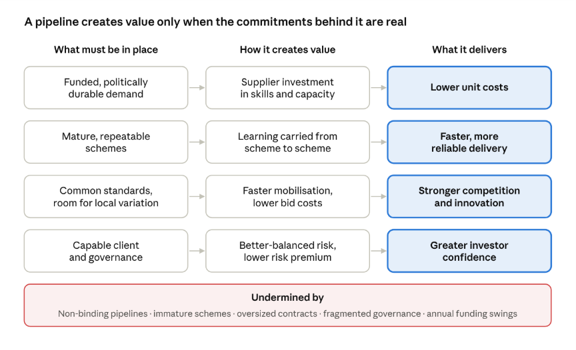
A spatial development strategy tells the market where growth is going. What we would call a 'pipeline deal' goes a step further, turning an SDS into firm demand that suppliers can invest against. A group of authorities with similar needs commits to a shared, long-term programme of work, and negotiates with the market as a single client.
The case for it rests on continuity. Germany electrifies railway lines more than a third more cheaply per kilometre than the UK, which Hall puts down to Germany never having stopped: people, equipment and expertise move from one scheme to the next and get better each time. The UK has tended to buy its infrastructure a project at a time. The Railway Industry Association estimates that a programme-based approach to electrification could cut delivery costs by around a third compared with a well-delivered standalone project. It also points to Transport Scotland, which has largely adopted that approach and now electrifies more cheaply than anywhere else in the UK.
Few city-regions outside London have the scale to buy that kind of capability on their own across most asset types; a group of them might. In that sense a pipeline deal applies to infrastructure delivery the logic of the cluster deals we have argued for previously, in which a mayor, central government and anchor investors each commit something around a specific industry.
The term needs some precision, because it is easily mistaken for a procurement framework. A framework sets the terms on which an authority can buy. A ‘pipeline deal’ is a negotiated bargain. Authorities commit volume and long-term certainty; in return, suppliers commit to investment in regional capacity and skills, standardised designs, and unit costs that fall over the life of the programme. The authorities' future demand is the bargaining chip.¹
Take housing retrofit as an illustration. Three strategic authorities each procuring around 150 schemes over three years are, to a supplier, three modest and uncertain contracts. The same authorities agreeing a common specification and a published programme of 1,500 schemes over ten years are a market worth building a factory, a training academy or a regional depot for. That changes what can be asked for at the negotiating table.
One live example is Bristol City Leap, a 20-year partnership between Bristol City Council, Ameresco and Vattenfall, which uses a single long-term platform to bring together housing retrofit, heat networks, EV charging and renewables. Its record is mixed in places, with some strands held back by national regulation, grid connections and planning decisions outside the partnership's control. Mayors can only offer certainty over what they and their partners actually control.
Nor does a long programme mean a long wait. A pipeline deal can open with an early tranche of schemes that are ready to go, and suppliers with a committed programme mobilise faster than those bidding for one-off contracts. The long-term commitment is what buys speed in the short term – visible delivery within a mayoral term, with a pipeline behind it.
A pipeline also imposes a useful discipline, because it cannot be published until each scheme is properly defined, which forces the trade-offs between cost, standard and outcome to be settled early. HS2 is the obvious warning of what happens otherwise: the Stewart Review found that the business case behind its Phase One Hybrid Bill rested on a design only around 4 per cent mature.
This requires mayors to work closely together. The economics – and the potential political dividend – make a strong case for doing so. But the value only materialises if the groundwork is done properly. As Hall's account of HS2 suggests, getting the policy, planning and negotiation right at the start is what separates a programme that drives costs down from one that simply locks them in. Without funded demand and proper governance behind it, a pipeline deal risks doing exactly that.
The Whitehall trade
The case for devolution is usually made in the language of local empowerment. However, the strongest negotiations with the Treasury are made in the language of Treasury incentives.
The Treasury's instinct to hold capital at the centre is not irrational. It is how the Treasury controls spending and protects value for money when it does not trust the alternatives. A mayor who argues for more freedom as a point of principle runs straight into that concern. A mayor who addresses it directly is in a very different position. When I negotiated with the Treasury on spending as a special adviser, the cases that succeeded were the ones that solved a problem for the Treasury as well as for us (even in cases where we had helped create – or amplify – the problem in the first place).
That points to an outcome-for-autonomy trade. Rather than asking for a bigger pot, a mayor offers the Treasury transparent, measurable commitments on outcomes, delivery and unit costs. In return, the mayor seeks a multi-year capital settlement and the freedom to pool funding streams and sequence schemes. The Treasury gets the assurance it actually cares about without having to take every decision itself. The mayor gets the stability that brings costs down.
The model already exists in embryo. As Witcherley explained on our podcast, an integrated settlement works much like a spending department's budget: the authority agrees an outcomes framework with government and gains some flexibility to move money between pots, and between capital and revenue. The opportunity is to extend that logic to long-term infrastructure capital.
For a mayor, the prize is as much about time as money. Much of a term can be consumed by the cycle of bids, business cases, approvals and deadlines before a spade goes in the ground. A multi-year settlement takes most of that cycle out.
A pipeline deal strengthens this considerably. Committed supply-chain investment and falling unit costs are exactly the evidence the Treasury needs before letting go of the purse strings – and a far more persuasive proposition than a dozen separate bids.
In its 2024 report on the cost drivers of major projects, the National Infrastructure Commission (now part of the National Infrastructure and Service Transformation Authority) identified the lack of a trusted pipeline of work as a root cause of high costs, and argued that a more programmatic approach would allow greater standardisation and lower unit costs.
The obvious objection is that the Treasury has behaved this way for forty years and is unlikely to stop now. That is fair, although Witcherley, whom I first worked with when we were both Treasury officials, finds the department far more attuned to the regional agenda than it once was. Either way, the aim is not to persuade the Treasury to become less Treasury-like. It is to put forward a proposition strong enough that officials can justify behaving differently – to their ministers, and to themselves.
The Treasury is not the only audience in Whitehall, though, and it is not (at least now) the one that sets the political weather. No 10 and the spending departments are buying something different: delivery of the Prime Minister's agenda, and visible proof that it is working. Burnham has made clear that he wants a decade in power and a settlement that lasts, and he has promised the biggest social housebuilding programme since the post-war years.
Ambitions on that timescale need delivery vehicles that outlast a spending review, and Whitehall is not well placed to build them itself. A mayor's ten-year plan, already agreed with neighbouring authorities and the market, is ready-made machinery for a national mission. Its early tranche offers something just as valuable: tangible progress well before the next general election. On this point, the mayor's four-year clock and the Prime Minister's electoral one run to much the same timetable.
Framed this way, a plan stops being a local request and becomes an offer to deliver the Government's priorities. That gives departmental ministers a reason to champion it in their own negotiations with the Treasury – which is often where these arguments are actually won. The one caution is that the more closely a plan is tied to a national mission, the more exposed it is if priorities shift.
Getting the risk right
The third form of certainty concerns risk. Government has a long habit of passing too much of it to the private sector – planning risk, policy risk, demand risk – which either makes projects uninvestable or so expensive that they fail value-for-money tests. Hall cited Hinkley Point C, where, in his account, Government's decision to cover the cost of flooding during construction helped bring the project's financing costs down to something close to a regulated utility.
Mayors are often well placed to hold or reduce certain risks themselves, particularly those around land, planning and local consent. In Witcherley's experience, this is what investors most want from a region once the national red carpet has been rolled up: sites and skills, and a partner to see them through planning. Mayoral development corporations, which any mayor can now establish, give them a vehicle for doing so, with powers to assemble land, act as planning authority and put in infrastructure. Those are assets to be traded against private investment, and the kind of allocation that makes a deal stand up both commercially and in the Treasury.
There is also a second negotiation here, and it is easy to overlook. The most important negotiation is often not the one taking place across the table, but the one that happens inside Government afterwards. A mayor negotiating with investors will have to defend the result to their strategic authority, their electorate and Whitehall. A proposition designed only to persuade the mayor is unlikely to survive that journey – and businesses dealing with mayors should build theirs accordingly.
The missing capability
This is where the problem set out at the start – ambitious mandates, thin resources – bites hardest. Strategic authorities are generally well equipped to decide what should be built; the capacity to negotiate the conditions under which it gets built is more uneven, and complex commercial deals often need dedicated support. That is the gap Negotient works in. We help public authorities design and negotiate the deals – with Whitehall, with neighbouring authorities and with investors – that turn an infrastructure plan into a bargaining position, and a bargaining position into delivery.
None of this is glamorous, and the negotiating itself will not produce a good photograph. But four years passes quickly, and mayors who spend the first two of them bidding for pots are unlikely to have much to show for the last two. A published plan on its own is only information. Those who use theirs to negotiate certainty – with Whitehall and the market, and with each other – stand a far better chance of having something built by the time voters next pass judgement.
This article draws on themes discussed by David Gauke and John Hall in Negotient's latest Negotiating Government podcast on why UK infrastructure costs so much. Listen here.
It also draws on James Dowling's earlier conversation with Phil Witcherley of the North East Mayoral Strategic Authority on devolution as a negotiation.
¹ The idea builds on existing Cabinet Office guidance, which encourages contracting authorities to bring work together into portfolios and to look across the public sector for opportunities to do so.