
Podcast > Episode 10
Devolution is a Negotiation: Delivering Successful Regional Government in the Northeast
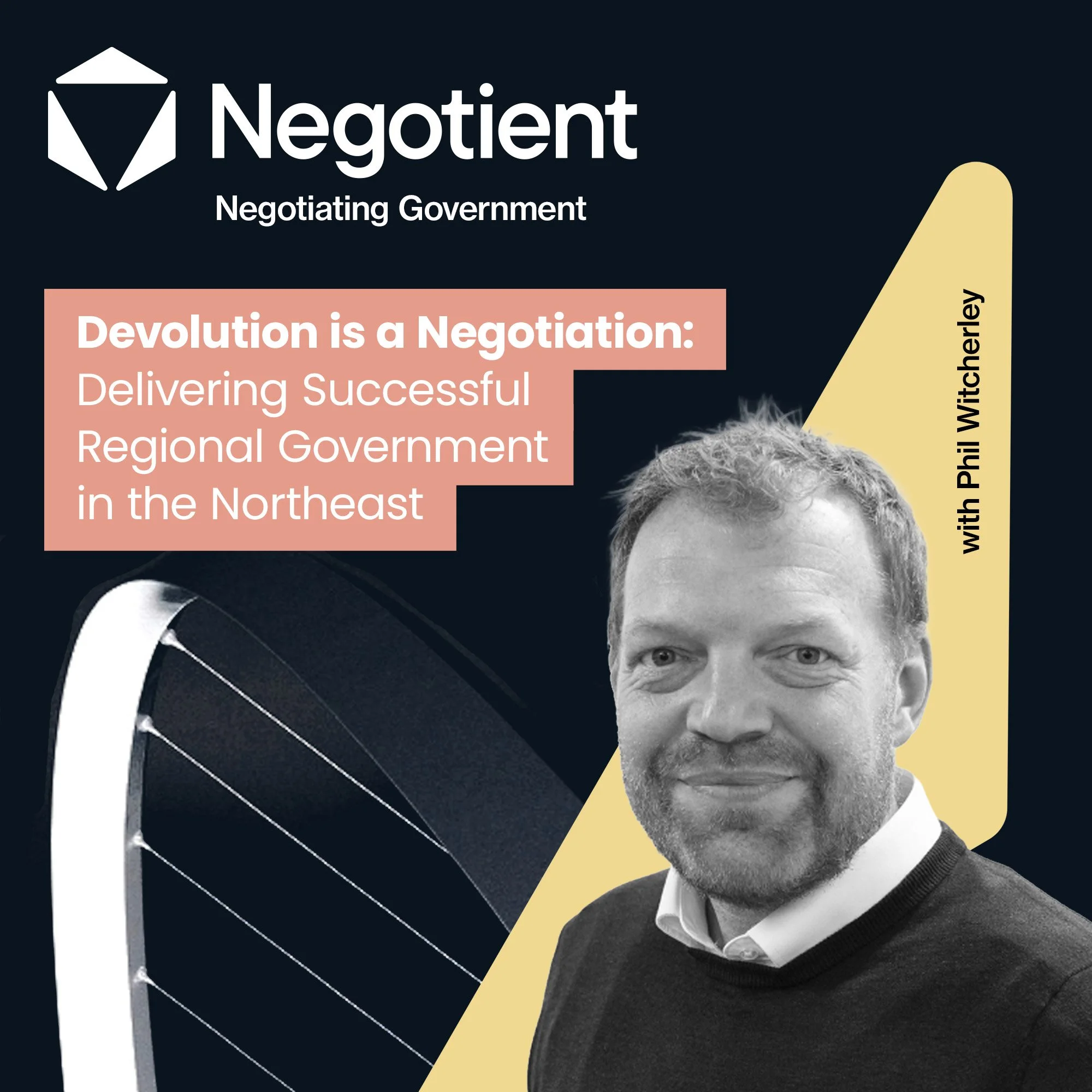
The English Devolution Act 2026 has just passed — but how do combined authorities actually negotiate the deals, powers and investment that make devolution work in practice?
Phil Witcherley, Director of Economic Growth and Innovation at the Northeast Combined Authority, joins James Dowling to reveal the strategy behind building regional coalitions, securing integrated settlements and attracting private investment. An essential listen for businesses, investors and public sector leaders navigating England's new devolution landscape.
Subscribe:Devolution is a Negotiation: Delivering Successful Regional Government in the Northeast
With the English Devolution and Community Empowerment Act 2026 just receiving Royal Assent, England is entering a new era of regional government. But how do combined authorities actually negotiate the powers, funding and investment they need to deliver for their regions?
In this episode, James Dowling is joined by Phil Witcherley, Director of Economic Growth and Innovation at the Northeast Combined Authority and a former HM Treasury official, for a frank conversation about what devolution looks like from the inside.
What you'll learn:
Why devolution should be treated as a negotiation — not a grant application — and how that mindset changes outcomes
How the Northeast Combined Authority built a regional coalition of businesses, local authorities and private sector partners to strengthen its position with central government
What an integrated settlement actually means in practice, and why it represents a fundamentally different relationship with central Government compared to traditional grant funding
How Phil's background as a Treasury official gives the Northeast a strategic advantage in understanding what central government actually needs to hear
The growing role of combined authorities in attracting foreign direct investment — and why businesses increasingly want to deal with regional government, not just Whitehall
How private sector partners can use the devolution agenda as a lever for joint investment in regional infrastructure
Featured on this episode

James Dowling
Managing Director
James is an expert in UK public policy, government, and politics.
James led the public affairs and public policy practice of a major London consultancy, working with public companies and privately-owned clients across sectors including financial services, transport, and energy. He is a former UK government senior official and Special Adviser. As a civil servant, he worked at HM Treasury on tax policy and financial services. As a Special Adviser, he led on political relations and negotiations with No10 and HM Treasury on policy issues, public spending, legislative programmes and Parliamentary engagement. James is a regular media commentator, has written for the Telegraph and the Express, and often appears in broadcast media such as LBC, TalkTV and Sky News.
James combines political, media and government experience with commercial understanding. He advises clients on their public policy, political, and stakeholder context in the development and delivery of effective negotiation strategies.

Phil Witcherley
Director of Economic Growth and Innovation, The North East Combined Authority
Phil Witcherley is Director of Economic Growth and Innovation at the Northeast Combined Authority. He has direct experience of both sides of the devolution negotiation — as a central government official and as a regional partner.
He spent the first decade of his career in Whitehall, including at HM Treasury, before moving into local and regional Government; immediately before joining the Northeast Combined Authority, he was a Deputy Director at the Treasury's Darlington office, before moving into combined authority work.
He has direct experience of both sides of the devolution negotiation — as a central government official and as a regional partner.
Transcript
Welcome to Negotiating Government, the podcast from Negotient. I'm James Dowling, founding partner of Negotient. So, Negotient is a firm which specialises in helping its clients, whether in the public or private sector, negotiate better deals across the public-private sectoral divide.
So to that end, the English regional devolution agenda really interests us as successful devolution depends on successful negotiations between many different parties of different levels of government, and indeed between the public and private sectors. So absolutely delighted to be joined today by my very good friend, Phil Witcherley, Director of Economic Growth and Innovation at the North East Combined Authority, and a confession of a seedy background, a fallen repeated official at HM Treasury. Phil, thank you for joining me.
Thank you. And it's quite funny, you started with the repeated person at Treasury, because my combined authority colleagues always make fun of me for repeatedly referring to repeatedly working at the Treasury, which I always try not to do, but it's a good kind of introduction. So good to be on the podcast, James, and thank you for inviting me on it.
So just to kind of frame the overall thesis, the way that Negotient looks at this. So we took the view and we've taken the view from the start that devolution is a negotiation. It's not simply a grant application or a series of grant applications.
And you'll get further if you treat devolution as a negotiation and approach it in that spirit and incentivising all parties to put value on the table and participate in the process. We think that the private sector can become a vital ally in bolstering your case with central government or indeed with other partners.
I think that's a really kind of astute perspective. I constantly see it as a massive part of my job trying to explain to the world what combined authorities actually are and what mayoral combined authorities actually are, because I think we are nascent new organisations that have distinct identities, but that point around us being in a constant state of negotiation is completely true, I think. Whether that's a negotiation with government for an integrated settlement, a devolution deal for powers, or whether that be how we assemble what the economic priorities are for the region, working with our elected mayor and the business community, how we work with our seven local authority partners to make sure we're driving the best outcomes. So it feels like we are constantly in a state of negotiation.
And it's a fascinating kind of set of things which I think we should get into. So I mean, just kind of reflecting as you were talking about that, partly on kind of where you're going, it's your missions, isn't it, I think, but also then kind of what you've got to play with and you've listed out the relationships, the partners that you've got to help you deliver on those missions. I mean, I think this is interesting, because what you've done is to build a slate that you then take to the outside world, regionally, international government, and it's your bid for funding, if you like.
So one of the ways we look at negotiation is, it's a product of a mix of interests and thinking through in a creative way how you square those interests within a particular contextual framework to deliver a certain set of strategic goals. Yes. So the way that you actually conceive of your coalition, your bargaining slate, it necessarily influences then how your likelihood of success, because it impacts the amount of overall kind of pie that you can win at the end of it.
We haven't just taken the government's industrial strategy sectors, we thought about things like the foundational economy and the retail hospitality sector, social care, tourism, because that's the engine for a lot of jobs for the North East. And we've worked really, really closely to develop that with our local authorities and with our local business community. We have both a business board, which has a number of people from the business community on it, but we also have regular conversations with the sectors as well.
So when we're developing, for example, what our strategy is for clean energy, we're working directly with the clean energy sector to design that. And this means that when we go to government and negotiate packages or work with them on packages of support that might be unique to our combined authority, or unique to combined authorities with sectors like ours, we have a lot of credibility because we can give real examples of large businesses like Sage in our region, which is the only kind of FTSE 100 listed business, I think, in that space in this country, or having Nissan in our region, you know, having some of that kind of local business community involved as well. So Sunderland, for example, have been working with the automotive sector for a very, very long time.
We'll work with Sunderland Council and other local authority partners about how we build it up. So it's very much convening that what is the best way to make that argument and negotiation across a range of different partners.
The way you're talking about it, I think, is often different from the way businesses think about their relationships with the state, if you like, whether it's kind of central government or local government. And they often, I think, the private sector, partly because it just doesn't understand, you know, if you've been in business for your entire life, the public sector marches to the beat of a very different drum from what you're used to. And so you don't necessarily understand how to relate to government, whatever bit of government, to get what you want out. But it feels like you have successfully built a coalition where you've brought a lot of your local delivery partners, whether they're in the reason to join you.
I think it's great. It looks like that's the outside world. The community is incredibly tight in the North East. So it's very, very, one of the benefits or advantages we have, and it can sometimes be a disadvantage, that everyone's kind of one or two steps removed and it's much closer connected. So you can always get to the right people and know the right people pretty quickly in terms of getting stuff done, which has really, really helped build that regional coalition. So kind of that outside perception is very important.
And we really, really value the need to kind of have the difficult discussions internally and then have this united front externally.
You're also, I mentioned at the start, you're a former Treasury official, you're a former central government official, and actually your job immediately before this one, you were in the Treasury in Darlington this time. And so interestingly, you've kind of straddled both worlds. How far do you feel that your experience as a, and you weren't just in the Treasury, but you were most significantly in the Treasury, as a central government official has helped you really understand where and head off or just play into some of the interests that you see in central government?
I spent the kind of formative years of my career in the Treasury, in and out of Treasury for the first kind of decade of my career. And then I've had a number of jobs in between coming to combined authority worlds. I think the experience of going back into the Treasury after you've not been in there, but being in the world I'm in now was really, really interesting.
As we know, it's a great department with great people in it. And it's also kind of dealing with what I consider to be just this kind of series of impossible questions like the rest of the public sector is. It's an incredibly difficult job and the Treasury gets a lot of flack, but actually is doing an incredibly important and difficult job.
Compared to kind of the noughties and now, the Treasury is much more kind of attuned to that kind of regional agenda. I've got a sense of, you know, when you are in a negotiation, you are talking to colleagues with different lenses. I've got a real strong sense of the lens that they're facing. And, you know, the things like the general expenditure policy team and, you know, the spending review process, making sure that there's good value public policy decisions. And alongside the lens that they see in terms of the UK economy and UK economic growth. And, you know, it's a slightly different lens, but broadly, I think there's quite a solid overlap actually between what they're trying to achieve and what we're trying to achieve.
I think what regional politicians are saying and things like the right to request. So we've been asked to request for further devolution, which again is a negotiation. Mayors will always believe they're elected by a set of people from their region and from their region only. So they are in a good position to understand what their people want. So on a swathe of areas from kind of, you know, arm's length bodies and regional spend, there's been a big push for further devolution of that.
And to answer your question directly around what, having worked in departments or adjacent to those departments, I've got a good sense about how that's going to land and how to make sure it lands in the best way. And also to help people in my organisation understand why they think things that might be quite frustrating and work them through, you know, so we try and move to the outcome we need or as close to the outcome we need it to be.
We can do things like our local growth plan. We can assemble a business community that will be supportive from an economic point of view of what they want to do. And also we can help attract investment into the country, which is not, you know, it's almost, you know, we can be part of the Office for Investment and when, and we often do that actually, my team do that in terms of foreign direct investment into the country. If a business is interested in investing or bringing a lot of money in, we help concierge that to the right place. And we help support and have some of those conversations.
So it doesn't have to be the Office for Investment that has all of those conversations with the high value foreign direct investment businesses coming into the country. And actually it's often what those businesses really want. So they want to do that Number 10 Office for Investment red carpet bit, but actually what they really want to do after that is they want to kind of see the sites, know that they've got like the local skills in the region, or there's a plan to build them in and know that somebody's going to kind of support them when they have those difficult discussions around planning with local authorities, their partners behind the investment.
And so we really have a role as a region to kind of help with that type of conversation. We should really be seen as partners in growth. And I think I really believe we are, to be honest, in terms of the conversations we've been having. So it feels like government is really gearing up to having that conversation with us in a positive way.
Could we just kind of talk a bit about integrated settlements and in terms of the kind of nature of the deal that you're under with an integrated settlement as opposed to a series of overlapping grants. What does that give you?
So we've got broadly kind of three sources of money from the kind of Treasury, if you like, one of which is our initial investment fund, which is just one set of money that is over 30 years. The second is we've got a series of kind of case-by-case grants for certain things. And then finally, we've now got the integrated settlement and we're just into the first weeks of that. So Greater Manchester and West Midlands have had that for a while.
It is essentially like a spending department budget. We don't decide what the overall amount is, but then we have a series of pots within that for different purposes. But within that, there's a lot of flexibility about how we spend it and what we do. So now we're moving to working out, do we want to spend it on what has been kind of identified for it? So we can shift things between budgets. We can shift a certain percentage between capital and revenue. And what we also have to do is, like spending departments have to do, we have to agree the outcomes we deliver for that budget.
So we've gone through a process of agreeing kind of the outcomes framework. And I think there's something quite powerful about instead of being given a grant for delivering specific things that's more output based, being given an integrated settlement to deliver a set of outcomes, you decide how you work out those outcomes — over to you. It's really, really powerful and it will be interesting how it pans out in the next few years, both of us and the other combined authorities that have got the integrated settlement.
I'm going to ask you one final question because you anticipated something I was to ask. You talk about the ability to invest locally in different projects. If you were a private sector entity thinking about making some investment, whatever it is, social infrastructure, housing, or I mean, it doesn't really matter. It gives you as a private sector partner the ability to potentially incentivise if you're willing to put some skin in the game. I mean, is that something that you are looking at increasingly, sort of joint investments or joint partnering?
So I'll answer that question in two ways. So we're already doing it. So we've got something called the North East Fund, which is a fund that's existed for a long, long time that we've just reinvested 70 million pounds into in the last year, which is for businesses in the North East that are kind of growing businesses, but have got some kind of market failure about how they can't get great investments. So we are kind of investing through that North East Fund to support those businesses to grow to a point in which they're investor ready.
On the wider point, there are a lot of conversations about how we take our investment fund, potentially work with local pension funds, to invest particularly in big ticket investments for the region. The other thing which I haven't spoken about is the Mayor's Recyclable Fund, which is another version of that. So every single combined authority kind of at our stage of maturity and even more mature is thinking about that and how we do that.
The focus, other than the business side I started with, is making sure we've got a property pipeline of investable projects that we can work with. And we've got a series of those we've announced recently in terms of kind of Gateshead Quays, Sunderland Riverside, Newcastle City Centre, Durham Innovation District. There's a number of projects where we're trying to unlock those projects basically with a combination of combined authority funding, but also trying to attract private investors alongside. And some of those have and some of those need.
So definitely that is something, but it is definitely a theme and a real growth area. And it's something that the government are very, very behind as well. They have this awful term called the PUFFINs, which is the public financial institutions, which will be invested with that as well. So I think actually that packaged funding is something we definitely need to be looking at and we are looking at, but it's just doing it in the right way and doing it at pace. It's really, really important.
And that's probably a good point at which to end. Phil, thank you so much for your time. You've been very candid, charming and... A little too candid, James. Well, I'm sure you trod a line, but I would like to think you were candid to me and I'm sure you would like to think you were guarded. And on that note, it's been lovely to catch up with you. Thank you so much for the conversation. Thank you, James.