
Podcast > Episode 12
Winning Government Defence Contracts: What the Defence Investment Plan Really Means
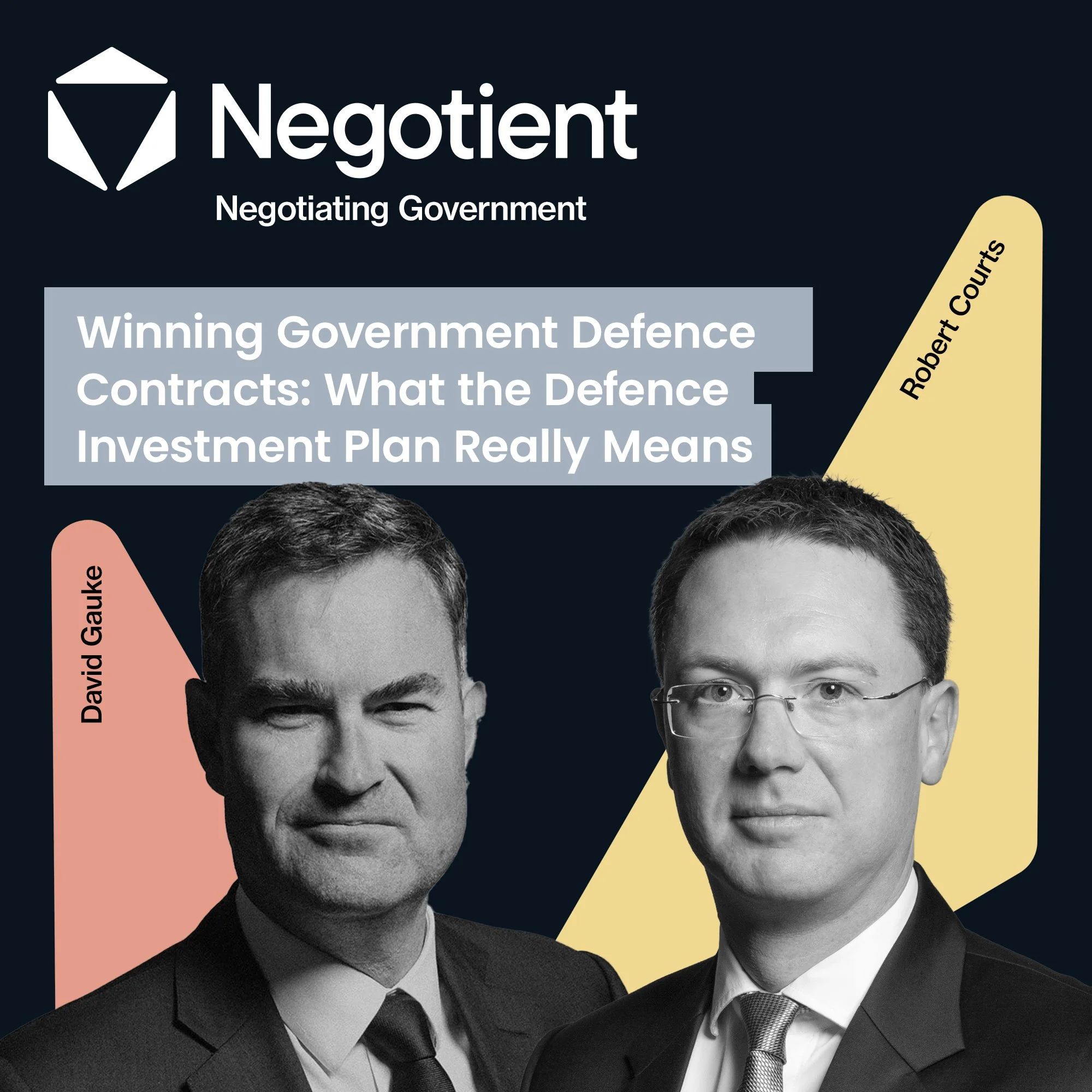
In this episode of Negotiating Government, David Gauke is joined by former Aviation, Maritime & Security Minister Robert Courts to explore what the plan really means for defence suppliers, technology companies and businesses looking to work with government.
Rather than treating the document as a shopping list of future contracts, they examine the strategic thinking behind government investment decisions and explain why political priorities, Treasury approval and strategic relevance increasingly determine which suppliers succeed.
Subscribe:Winning Government Defence Contracts: What the Defence Investment Plan Really Means
In this episode of Negotiating Government, David Gauke is joined by former Defence Select Committee Chair and former Defence Minister Robert Courts to explore what the plan really means for defence suppliers, technology companies and businesses looking to work with government.
Rather than treating the document as a shopping list of future contracts, they examine the strategic thinking behind government investment decisions and explain why political priorities, Treasury approval and strategic relevance increasingly determine which suppliers succeed.
They discuss:
Why the Defence Investment Plan is a guide to government priorities—not guaranteed procurement
How defence companies can become strategically relevant
The growing importance of sovereign capability and UK industrial resilience
Why Treasury thinking matters just as much as Ministry of Defence priorities
Lessons from defence procurement successes and failures
How AI, autonomy and rapid technological change are reshaping procurement
What CEOs should do now to improve their chances of winning government contracts
Whether you work in defence, aerospace, technology or government affairs, this episode provides practical insight into how modern government procurement decisions are really made—and how to position your organisation for success.
Featured on this episode

David Gauke
Chair
Negotient’s chair is David Gauke, a former Member of Parliament and Cabinet minister.
As Chief Secretary to the Treasury, David negotiated public spending settlements with Government departments and devolved administrations, led public sector pay policy, and engaged with policy issues including infrastructure investment, health reform, and defence procurement.
David is a City solicitor by background. He appears frequently in the media as a political commentator, is a columnist with the New Statesman and ConservativeHome, and edited the book The Case for the Centre Right.

Robert Courts
Director
Ascalane Partners
Robert is a proven leader in aviation, maritime, and defence policy, with a distinguished ministerial and Parliamentary career marked by transformational achievements.
As Minister for Aviation, Maritime & Security, and through his work on the Defence Select Committee and more widely in Parliament, he played a pivotal role in addressing historic challenges, fostering innovation, and shaping the future for the UK’s aviation, maritime and defence sectors.
Transcript
Hello, this is David Gauke, Chair of Negotient. Welcome to the latest in our Negotiating Government podcast. And I'm delighted today to be joined by my former parliamentary colleague, Robert Courts, former chair of the Defence Select Committee, Aviation, Maritime and Security Minister in the Department for Transport, Solicitor General, and now part of Ascalane Partners.
And he brings a very good eye to all matters defence. And here is our opportunity to discuss the Defence Investment Plan published on the 30th of June. Long awaited, to some extent, highly controversial, contributed towards the resignation of John Healey as Defence Secretary, which in a way contributed towards the resignation of Keir Starmer as Prime Minister.
So no small thing, but a really important document in terms of setting out where the government is going. Now, all we're not going to do today is do a line by line analysis of it all, a look at the numbers. I think what's more important is the sense of not just a spending document, but a guide to how the government is currently thinking about defence priorities, industrial policy, and the future of investment.
It's really a useful indicator of priorities than a precise procurement roadmap. So Robert, as someone close to this, welcome. Good to see you.
Great to see you and thanks for having me. Delighted you're with us today. So tell us, in terms of when you read the Defence Investment Plan, the DIP, what was your immediate reaction? Well, the first thing is that at least it's there.
I think that's the main thing that everyone in industry has been crying out for for a long time, because of course there are a number of different pillars to this government, and indeed any government's defence strategy. The Strategic Defence Review last year sets the strategic direction. The Defence Industrial Plan tells us some of how that's going to be delivered and their overall policy to procurement.
And the Defence Investment Plan is intended to tell us how that money is going to be spent. And for a long time now, it will surprise no one, since the podcast industry has been needing to see something, because nothing can be signed until that document is out, because the system understandably is awaiting the release of the plan that will tell us how we get to realising the SDR. So that's the first point, is thank goodness it's there.
The second is shame some of the politics of it. A lot of the coverage thus far, as you as you'll know, has really fallen into one of two or three brackets. There's the political side of it.
There's the, is it enough money? There's the what side of things. Then there's the military saying, well, this is the capability that we need to have. And then there's industry saying, well, at least we've got the plan that we need.
But I think really the most interesting bit is the bit that isn't spoken about so much, which is that this isn't a shopping list of things that are definitely going to be bought. Some of that in there. What it's much more interesting about is a direction of travel of what the government is going to be looking for when making procurement decisions.
There's a lot everyone can learn from that. Yeah, I think that's absolutely right. And I suppose it's worth just sort of stepping back and asking, what is the government trying to achieve? What do you think we've learned from the government's priorities from the publication of the DIP? Yeah.
To a certain extent, I think the DIP has to be seen as SDR mark two. It isn't a line by line. There is, of course, some financial allocation in there.
There's a lot that still needs to be worked out. The political background to it can't be ignored. You're absolutely right that its absence led to John Healey's resignation.
And really that led to Keir Starmer's resignation at the same time. And the fact that we have an outgoing Prime Minister who is looking to have a legacy is clearly a part of this as well. I think there's a number of things that come from that.
Firstly, I think, is this the last word? We have a new Prime Minister, almost certainly to be Andy Burnham, and shortly to be anointed. It is very difficult to see that he can do anything other than to take a look at this holistically in the round. The calls for increased spending are going to continue coming.
What we had seen here is, perhaps in more detail in due course, only part of what the military says is needed merely to stand still. But what it is very helpful to us is looking at, we can tease out some real policy principles that are going to be increasingly important. The reason I've just talked about the politics a little bit there is that by necessity, a lot of it is still evolving.
So, for example, sovereign capability. That's the key in the SDR. As we look around at the threats to the Transatlantic Alliance, as we look at the challenges facing NATO, as we look at the real resurgence of great power conflict for the first time in any of our adult lives, the nature of that threat is still something that is evolving.
As we start getting into the policy and the procurement choices, the truth is that actually a lot of it is still evolving. We'll get into this in the unmanned, the AI sphere, perhaps in due course. So a direction of travel around sovereign capability, around resilience, around supply chain assuredness, around ensuring that we are not just looking at bits of kit, but we are looking at the whole delivery capability is, I think, really key.
That last point is probably the most important at all, and perhaps we just will pull this out a little bit more, that in the past, government really would be looking at producing in the aviation world a thing with wings. Increasingly, that platform is less important. The thing that is more important is the capability that is loaded upon it.
So the platform itself may be around for decades, and some great examples of that now, but the capability that is on it will iterate, as we see in Ukraine, on a day-by-day basis. So that flexibility is really key. Yeah, I think that's a really important point, and certainly an important point that suppliers need to take on board, is the government is essentially working out what its capabilities are.
How it delivers those capabilities is likely to change, and there's, I guess, got to be greater flexibility now than perhaps in the past, just because of the speed of change. I mean, everyone just looks at what's been happening in Ukraine, and the capability is always important, but how you meet those capabilities have changed very rapidly. The concept of spiral development, for example, is absolutely key.
And when companies are looking to bid in, to get a contract from a government, or just to have an offering that is of relevance to defence, showing you have flexibility to do that, you can get something into service that is good enough for now, but can be built upon and spiralled upwards as time comes, will be absolutely key. The big challenge for the defence industry, of course, has been that, historically, platforms take decades from conception to being brought into service. That isn't going to work in the threat environment that we have now.
Now, I think that's absolutely right. And yeah, I think, as I say, the lesson for suppliers is understand what sort of defence ecosystem the government is looking to have, and then meet those capabilities. There was something you said a moment ago, Robert, that I thought was absolutely spot-on from the perspective of the Treasury, which is this isn't a shopping list, and don't necessarily assume that if something's there, you've got everything sorted.
Because I'm conscious that this has been produced by the MOD, obviously working in conjunction with the Treasury. But speaking from my perspective as a former Treasury Minister, I'm very conscious that support for a particular project, a particular contract, is not going to be automatic. There's always going to be... Well, first of all, there is still a tension between aspiration and expenditure, and whether that can be met.
But also, that sort of sense that the Treasury is always going to be asking the question about any contract. Do we really need it? Can we afford it? Is this good value for money? Those questions will remain in place. And I guess there's a risk for suppliers in being perhaps too complacent if they say, oh, we've got a mention in the dip, then we're all fine.
You've still got to persuade the Treasury, as well as the MOD, that a particular contract meets the government's requirements. Yes, that's absolutely right. And I've seen that from the perspective that I've had in Parliament and in government.
I think it's probably worth separating out. I mean, you and I know what we've been through, and it's worth everybody realizing. There are multiple decision gates within government, and you can have an in-principle decision.
And that in-principle decision is often announced as being, we are doing X. But X can very soon be undone later if the procurement model doesn't work or if Treasury refuse to fund it. And they may do so through concerns about value for money or deliverability, for example. But I think one of the key things that is worth people understanding is that very often companies look at an offering that they have, and they will say, in this context, we have an outstanding military capability.
And then we'll think, well, therefore, that means we ought to be the winners. And you may well find that within MOD, they have their cheerleaders, and their cheerleaders may well very much agree. But there are two critical stages.
I don't mean the formal Treasury stages, but the formal ones you have to get through as well, which is the political support and the financial support, i.e. the Treasury support. In other words, you may have a technology that is first class, but it has to be something a minister can sign off and can want to sign off from a political perspective. So it has to answer strategic political goals.
Come back to some of those in due course. And even if that's the case, it still has to be something that can be reliable, as we know, and you can get more flesh on the bones of this. From a Treasury perspective, it has to be real value for money within a Treasury understanding of the phrase value for money, not what members of the public might feel that means.
It has to marry up against the Green Book, for example. Now, let me give you a very good, let me give you a worked out example of what I mean by that. Many within the armed forces may wish to have a capability in military terms that is established, that is mature, that is operationally proven, and is top of the class.
Now, that may mean a capability that comes from abroad. Then, so they may say, this is the capability we want. Now, you may have a political layer over that, which says, well, that may well be the case, but I can't possibly give the award to that company because that means jobs in this part of the UK aren't going to be awarded.
So politically, I can't support it. Even if you can get through that, then you may get to the end stage where Treasury will say, well, yes, but it's twice as expensive as another version, or they've had procurement failure in the past, which means they aren't reliable. So it's a classic mistake to simply address that first capability change and not think about the political supportability of it and the Treasury financial supportability of it.
At the end of the day, you have to remember this. However good your product may be, you have to allow the officials to crawl over it with a slide rule and a spreadsheet and to be able to send it up to ministers to say, this is a good thing. Not only you may wish to approve it, but it actually can with an eye to public money.
Yeah, I think that's a good point. And Andy Burnham, and I guess by the time that our listeners are listening to this, Andy Burnham will be Prime Minister. He has made comments about the focus on building in Britain.
That will at times be in tension with the Treasury officials who will be saying, well, hold on here, we've got to get best value for money for the taxpayer. And by the way, the Treasury tends to be suspicious of the economic arguments by British thing, because they'll argue it's displacement and it's not actually creating any additional economic activity or not very much economic activity. So that's another challenge for suppliers is you've got on the one hand a kind of buy British position coming from number 10, but also sort of number 11 might be a bit sceptical.
There's also just a very, very good point. There's also the definition of what buy British really means. It's not that simple.
Because it's not as simple as that. And you may have a British Prime, but the subcontractors aren't, or even if you're not digging the subcontractors just down in the supply chain. So what is the definition of buying British? And to what extent are you prepared to go out on a limb in order to make that real? What Andy Burnham said is not really a radical departure from anything John Healey said.
He made a very similar announcement only a few weeks ago. So that's MFD, orthodoxy, political perspective. But to be honest, is it terribly different from anything that would have come out of the Defence Select Committee in my day or anything that would have come out under the last Conservative government to where everyone is looking to put jobs and orders in British companies, if you possibly can, all sorts of good reasons for that.
But of course, when the rubber hits the road, as if, as I said a moment ago, you have to pay more. And there's one of the real tensions. If you're looking to have sovereign capability from a political perspective, you may need to have a situation where you pay more in order to provide the strength and depth that you would need were the supply chain to be unreliable and you need every resource to it.
Yeah, no, really good point. Now, on the subject of procurement, sometimes things do go wrong or seem to go wrong. The Ajax-owned vehicle has attracted a lot of criticism that procurement.
And I guess that's an example of reasons why government officials can be cautious because you get it wrong. And I know there were questions about how the accountability of all of this works, but delivery risk is real. And the consequences of failure can be far greater than the consequences of caution.
Is the Ajax case one that is a shadow that hangs over defence procurement in this country at the moment? Yeah, I would say, as would so many, we are in a period of unparalleled threat as a country. We need to spend much more on defence. Okay, it's easy for me to say that.
And the treasury will understandably say, you already get a lot of money in defence and look at the stories of waste and of procurement failures in the past. And there is, unfortunately, I think we all have to accept, there's quite a lot for me to point at. Ajax is the much maligned programme at the moment, the programme of record that is the poster child.
The Sheldon Review, those, and in case either of them produced a report into it about 18 months, two years ago, is an excellent piece of work. I would recommend everybody to read it and be familiar with it. Because if you can show that you are aware of and able to avoid the procurement mistakes of the past, and there's all sorts of things laid out in that, then you are going to put yourself in a better position when you're looking to get through the procurement scenario.
But it's not to say you have to, which is the one to come over to. I mean, your treasury, of course, has a long institutional memory. It will look back to things like Nimrod MRA4 and look at the issues there.
And then it will even look back to things, back in the 60s and the 70s, or even things like typhoon procurement, which took over the course of decades. And lots of people will criticise that, though absolutely outstanding, mature platform that it now is. And my point is not to criticise any individual platform.
My point is to say to people that it really does repay your study to look at how procurement has been done in the past, learn lessons from it, and shape your offer so that you can avoid any potential criticism in the future. Yeah, very good advice. So let's move on to the question here about why some companies succeed and others don't, and this point of strategic relevance, which we've already touched on, about how to be strategically relevant.
Because I think the key thing here is to approach government from the perspective of what the government's objectives are, as opposed to, very obviously, from the perspective of what you want to sell. Obviously, you're going to do that, but you're going to be in a stronger position if that's the approach you take. In terms of companies needing to become strategically relevant, what advice would you give to any business in those circumstances? Instead of looking at what it is you have to sell and trying to persuade people that they should be buying it, look at what the government's problems are and how you can solve them.
I think one of the biggest mistakes that I see often made in industry is that people will say, I have this incredible product. It's a no-brainer to buy it. Why don't they do this? They're doing something else, which is more expensive, less good, and my product's better.
Oh, and by the way, if they only were to do this, then I could add a load of value into this part of the country. But the problem is, as you and I will well know, everyone says that. And when that guy leaves the room, you've got another five people outside waiting to come and see you who are going to say exactly the same thing.
And your officials will then have to go away, evaluate their offers, and we'll come back with one of them. And we'll say, well, actually, I wonder how this first offer is really going to be delivered. So instead of focusing on the thing that you have that you want to sell, think about what the government's strategic objectives are.
So if you're going to be investing in industrial capability, what have you done so far? What can you prove demonstrably you have delivered by way of value to the UK economy rather than simply saying, I will do this if it's contingent upon that, because that has all been heard before. And both MOD ministers and the Treasury have long institutional memories and are well aware of the occasions when that delivery, when the exciting pitch is not delivered in actual reality when the contract is delivered. So go back to history and show what you've actually done rather than what you're promising to do, and then marry it up against the government's stated objectives.
And very helpfully, the government publishes all of these. So reading the SDR, reading the defence plan, the defence investment plan, marrying up your offer against those strategic publicised objectives and reading the Green Book and understanding how it operates and what the Treasury is going to look at. Because at the end of the day, they've got to sign everything off.
Yeah, absolutely right. And that sense of making sure that the proposition helps solve a priority problem. That ministers and officials have in a way that they can support what is key.
And that point about government is complex. It's not just one organisation. It might not just be the MOD who you are.
It might be the people you're talking to, but the MOD is then going to go and persuade the Treasury. And you've got to equip the MOD with the arguments that will work with the Treasury. That's absolutely key.
I think understanding the complexity of government and the differing rationales, that Treasury may not be at one with MOD on a particular issue. I think just to answer your unpack, to pick a little bit more, actually a question you just asked me about strategic relevance is also differentiate yourself from others. So I gave the advice a moment ago about the real examples of where you have delivered in the past.
So it's not just theoretical, but also showing you how you differentiate different mothers. And for example, at the moment, everyone talks about AI. Everyone talks about technology.
Everyone talks about autonomy. Everyone talks about sovereign capability. Everyone talks about affordability.
But simply saying the buzzword, it still has to be unpacked in real terms. And what people are increasingly going to be looking for at any part of government is can you integrate with other systems? Can you deliver of scale? Yes, the Treasury, of course, the affordability will be key. And do you have the ability to produce mass in quick order? Because that's the strategic issue that we're facing at the moment.
Yeah, that's really helpful. Now, we've touched on already this point about by British, if you like, and sovereign capability and so on. And there's clearly a close link between industrial strategy and defence strategy.
And we've seen that already. And we'd like to see more of that with Prime Minister Burnham. How strongly do you think the industrial story really does resonate with government? Yeah, this issue really goes to the key of the procurement battles over the course of the last decades.
And it shades into the point I made a moment ago around the ability to require sovereign capability and then have to pay slightly more to get it. It really does. But it doesn't trump everything.
So as I said a moment ago, I don't think that in some ways anything that Andy Burnham said is anything radically different from what John Healey had said. And in truth, I don't know that very many people on other sides of the House would say that as well. If you look at conservatives or even reform, there's something about UK companies, UK sovereign ability.
They put it in a different way, but they're after the same thing. So yes, it does matter. And it's a key part of providing strategic relevance in terms of if we end up in a war situation, you need to know that you've still got a sound supply chain and you need to know that you can resupply your stockpiles, you need to know that you're not going to have your supply chain cut off by any emergency.
But it doesn't trump everything. And however good your story is on that, you do still have to be affordable in treasury terms. And therein lies the tension.
And of course, with administrative procurement, there's been this battle raging for a long time. You know, there is an argument and those who would say, if you want your armed forces to have the best kit, well, buy it off the shelf from the Americans because they battle tested it. They've got vested class.
They've got the mass of their own huge armed forces. And you can do that and you'll get a lot of really good top quality kit, but you don't have sovereign capability and you don't have your own industry. Well, if you do want your own industry, your own defence industry, if you do want sovereign capability, well, then you have to do something in order to buy into it.
That, in my views, is so important. We haven't mentioned that yet. It's one of the big winners of the dip.
I led the parliamentary debates that called for the development of such a programme because I was mindful of the decades it took to develop Typhoon in particular and how it changed in requirement terms over the decades. The longer it develops, the more the requirements change, the more expensive programmes generally would get. And GCAP, at its very heart, it tends to be described in the press as the fighter jet, the RAF's fighter jet.
Yes, there's a fighter jet in it, but there's a whole system of things that will go around it. And it's not just Royal Wingmen drones going alongside it. It's also the capability.
Above all, it's the defence industry. It is jobs. It is high skilled people who are able to provide the UK with the defence security resilience that it needs in a world like this.
So, yeah, really good point. Now, let's just come back to technology. We've already talked about it a little bit.
And the AI is obviously very important, is an important part of the DIP. And everyone is, every defence company is also a technology company these days. How do you stand out in that environment? Yeah, it is the, because I said a moment ago, everyone says that in the moment, showing that you have the ability to deliver now, but also that you understand how to innovate on an ongoing basis.
And that is the extraordinary thing that we're seeing happening in Ukraine, is the fact that we are now talking about procurement timescales and trying and failing out on the battlefield, try, fail, build again on an ongoing day by day basis. So we have a real opportunity for industry in being able to show that they are small and nimble and forward looking and innovative, but that they're not going to fall over at the same, when there suddenly is an emergency. And therein is the challenge.
So do the nimbleness of small startups as against the established industrial power of large established companies, that has to be married together. And those who can do that are those who are ultimately going to say military, we want the kit. Politically, we're going to be able to sign it off, because it's dipping all those strategic imperatives that you have and treasury, you're going, yeah, we can justify putting money behind that as well.
Yeah, it's a really interesting area. I have to say we, at Negotient, we had a very senior, former military figure come in and talk to us at the beginning of the year. And he was making the point about how technology was changing Ukraine.
And this is, I think, just before it really did start making a big difference. And the AI drones programs, and so on, and being completely transformed. So, but it's, it's transformative in procurement terms.
That's the key thing. Well, one of the big mistakes in procurement, and again, as Mr. Bernal, listening to this, will need me to tell them, that the danger is always that people prepare to fight the conflict that's just gone. And the lessons out of Ukraine are really important to get right.
Now, the one about the future of air power is one that perhaps is another episode. It's a big one. But the way, the reason Ukraine is being fought the way that it is, is because neither side has air superiority.
And it is inconceivable that NATO and the West could fight in that way, because we are democracies. The sheer meat grinder of populations being fed into it is something that would be politically unsupportable. Here, leaving aside, the Air Force also don't want to do it.
It's a bad way of fighting. It doesn't play to NATO's technological edge, and clearly our publics wouldn't support it. But that is the background against which Ukraine is being fought.
So it is key, but we don't learn the wrong lessons from it. The right lesson, in my view, is speed of procurement. It is that constant adaptation, rather than simply assuming that because they're using low-tech quadcopters in Ukraine, that is what we should be doing.
Yeah, well, it's the process. Well, it's the process, precisely. They're being forced into a way of fighting that is suboptimal for them, and will certainly be suboptimal for the West.
Now, it would be great pity we've got you here not to say a bit more about aviation, given your ministerial experience on all of this. If you're looking at aerospace companies, what should they specifically be paying attention to? So they should be looking for those emerging opportunities where there is something that aviation can do that adds what other industries can't do. And when we look at, again, to go back to that Ukraine opportunity, the absence of air power control is why Ukraine is being fought in the way it is.
And it's a truly horrifying conflict. I mean, when you look at things like this mile wide, I think it's 30, 60 mile wide kill zone now, where no person can go because they're hunted by drones everywhere that they go. How do we ensure that we are able to deal with such a world or crucially stop it evolving in the first place? Because simply dealing with that in terms of land systems is suboptimal.
So look for those key opportunities. I think one thing that's worth looking at that we haven't touched on so far is the value of deterrence. And one of the things that's in the dip is it has a pivot talking about drones and technology in the future.
I don't think anybody would disagree with that. And it's reportedly one of the things that John Healey was unhappy about before his resignation. There is clear that's been rebalanced clearly, at least in the storytelling by Dan Jarvis.
And that's true. The bit that it's quieter on is the deterrence, particularly on air defense, because once you're into the world, you're using drones and you've already gone to war. And that is something we all want to avoid for any number of reasons.
So look for the thing that has the deterrent value. What is it there, a space company, that you can provide that no other person can so that can be procured so that bluntly hitting us isn't worth the pain that will come back? That's the message we have to give. Very good.
And let's conclude, Robert, and I suppose one simple question, if you're a CEO listening to this podcast. Thank you for listening. And you believe that your company has something the government needs.
What should you be doing next? Don't concentrate on the fact that you have something that the government needs. Make it possible for government to procure that thing. So the capability obviously is all important.
If your capability isn't up to scratch, you're clearly not going to get procured. But it is only the first step. You then need to have a really detailed understanding of the political world in which you are operating.
And you need your proposition to be attuned.
So it's answering every single point of strategic relevance. So that's all of the things around innovation, jobs and sovereign capability.
And then lastly, but by no means least, it has to be affordable, and it has to be something that means the Treasury can sign it off.
So your capability is only stage one. You need the political and strategic relevance too, and you have to have the ability for the Treasury to sign it off when looking at the public procurement rules because, at the end of the day, however great the capability is, it's still public money and still has to be measured against that test.
Now, very good advice, and always keen to remind people that the Treasury really matters here.
Look, I think to summarise, and in addition to what Robert's just said, the Defence Investment Plan is not a catalogue of future contracts. It is a statement of where the government wants to go, and those companies that will succeed are those who understand both the destination and the decision-making process that sits between the ambition set out and the procurement decisions that will be made in the future.
So I think the lesson from today's discussion is simple. At one level, technical excellence matters, but strategic relevance, political understanding, affordability and deliverability matter just as much.
Robert, thank you so much for your time.
Thank you to our listeners for tuning in.
This has been another Negotiating Government podcast from Negotient.
Thank you very much.