
Podcast > Episode 16
UK Budget 2026: What It Really Means for Businesses Working with Government
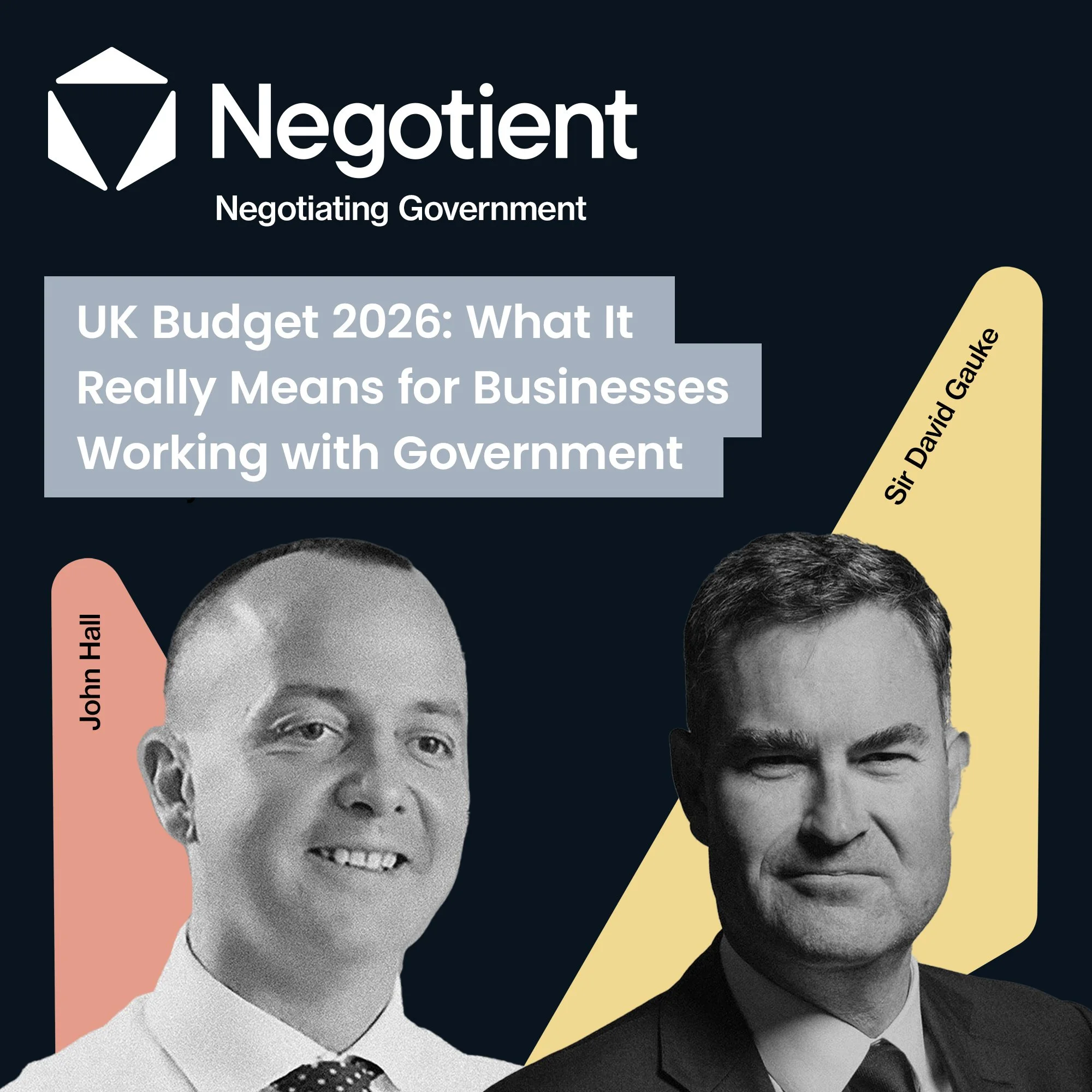
Beyond the headlines, tax announcements and economic forecasts, what does the UK Budget 2026 really mean for businesses working with government? And how can companies position themselves to take advantage of emerging commercial opportunities in an increasingly constrained fiscal environment?
In this episode of Negotiating Government, David Gauke is joined by John Hall, former Treasury and Department of Health official, to examine the political and economic context behind the Budget and its implications for public-private negotiations.
Rather than examining individual Budget measures, they explore the wider direction of government policy, the difficult spending decisions that lie ahead and how businesses can adapt their approach to engaging and negotiating with government.
Whilst tighter public finances, rising spending pressures and economic uncertainty present significant challenges, the Budget also signals a renewed openness to private finance, innovative commercial models and public-private partnerships.
Subscribe:The central lesson is that tighter public finances do not necessarily mean fewer commercial opportunities for businesses. However, they are likely to change the nature of those opportunities and how businesses need to negotiate with government.
What you'll learn in this episode
The economic and fiscal outlook: Why the Budget may have provided short-term breathing space while deferring difficult decisions on taxation, public spending and economic growth.
The return of private finance: How innovative financing models and public-private partnerships could unlock new commercial opportunities, particularly in defence.
The future of defence investment: Why credible funding commitments and greater clarity around procurement are essential for businesses planning investment and building capacity.
The changing role of social value in procurement: Why British jobs, skills and domestic supply chains are becoming increasingly important in securing government contracts.
New opportunities through devolution: How greater financial flexibility for mayoral authorities could reshape negotiations between central government, local government and businesses.
The potential of preventative spending: How businesses can respond to government's interest in reducing future pressures on public services, and why evidence and realistic financial claims matter.
Commercial creativity as a competitive advantage: Why developing innovative propositions, financing arrangements and risk-sharing models could help businesses secure better outcomes.
Changing government priorities, changing commercial opportunities
David and John examine how fiscal pressures are influencing government's approach to spending, procurement and investment.
The discussion highlights a renewed openness to private finance and public-private partnerships, particularly in defence, where government ambitions need to be supported by credible funding arrangements and private-sector investment.
Beyond defence, changes to social value requirements, the devolution agenda and the introduction of preventative departmental expenditure limits (PDEL) signal a broader shift in how government wants to work with businesses.
For companies, understanding these developments is important not only when responding to procurement opportunities, but also when identifying and developing new commercial propositions.
A different approach to negotiating with government
Successful negotiations with government increasingly require businesses to look beyond the conventional tendering process and consider the wider financial, political and operational challenges facing public-sector decision-makers.
The discussion highlights the importance of engaging early, understanding government's desired outcomes, developing credible evidence of value for money and exploring innovative ways to finance projects and allocate risk.
For businesses working with government, the message is clear: rather than waiting for opportunities to emerge, companies should be proactive in developing propositions that help government solve its problems whilst delivering sustainable commercial value.
Featured on this episode

Sir David Gauke
Chair
Negotient’s chair is David Gauke, a former Member of Parliament and Cabinet minister.
As Chief Secretary to the Treasury, David negotiated public spending settlements with Government departments and devolved administrations, led public sector pay policy, and engaged with policy issues including infrastructure investment, health reform, and defence procurement.
David is a City solicitor by background. He appears frequently in the media as a political commentator, is a columnist with the New Statesman and ConservativeHome, and edited the book The Case for the Centre Right.

John Hall
Associate
John provides strategic advice to public, private and not-for-profit organisations in the UK and internationally.
John is a former senior civil servant with 30 years’ experience in public spending, strategy, and public finances. He was strategy director in the Department of Health and director of economics at the regulator for NHS Foundation Trusts. As deputy director of public spending in HM Treasury he negotiated multiple spending reviews, infrastructure packages, and policy reforms.
John has a strong track record in building effective teams, coaching professionals to higher performance, and helping teams and organisations reorientate themselves to meet the challenges of the future.
Transcript
David
Hello, this is David Gauke, and welcome to the latest in our Negotiating Government podcasts. And today we are going to be talking about the Budget. It was obviously a few weeks ago, but now the dust has settled. We're not going to do an examination of every single measure and so on. But what we thought we would do today is talk a little bit about the political and economic context and what this means.
Specifically for those businesses that are dealing with government, because there's a fair few themes that emerge from the Budget that might well be of interest and worth bearing in mind. And I'm delighted that once again for one of our post-Budget podcasts, I'm joined by John Hall, former Treasury and Department of Health official who knows more about spending policy, quite a lot about tax policy than anybody else I know.
Right, so so John, what was this Budget all about?
John
On the one hand, I think John Healey's probably pretty happy for his first Budget. There was speculation beforehand that the bond markets would react badly, the sort of Kwasi Kwarteng test, and he passed that. And there were concerns within the Labour Party that it would prick the Burnham balance, and I think the sort of Rachel Reeves test you could call it, and I think he passed that one as well. He said he was providing breathing space for households in terms of cost of living support. I think the average household's gonna get about £150 over the next nine months. And that's gonna be dwarfed by the hit of more like four hundred pounds.
They're gonna take from Trump's folly in the Middle East. So disposable income's falling again in the context of a decade where it looks like the average person's only going to get two percent growth in household income. The Budget was big on measures. I think there was ninety eight of them in total, but pretty small on ambition.
All those 98 measures don't shift the dial on debt, and not one of them was scored as having a growth impact. So potentially politically popular, but they add complexity to the tax system. And because they're all a lot of them were temporary, they had a lot of uncertainty as to whether they're going to be unwound. So it might be that it actually provided more breathing space for the government. Because those major structural decisions on how to fund 3% of GDP on defence.
On how to reform the welfare system and how to deal with the big pencilled in slowdown in spending just before the general election. They've all been kicked into next year. It's probably worth saying as well that growth's been surprisingly strong this year. I mean, I think that's surprised most forecasters. Business investment is up and there seem to be a lot of stuff on AI. But the next two years are going to be tough. Because pencilled in, we've got higher taxes, we've got tight spending control and we've got higher interest rates.
All of those are going to suck demand out of the economy in the context of the government still not really having any growth strategy at all.
David
Yeah, I think that's all fair. This was billed beforehand as being a do-no-harm Budget. And in terms of the bond market, it hasn't done any harm there. In terms of the political popularity of the government, it hasn't really done any harm there either. But it has pushed a few problems down the road. And that I suppose might be an issue in terms of we're likely to see quite a lot of speculation next year. You talked about sort of some of the spending pressures. You know, that's gonna be difficult, that's gonna kind of build up. Is there a sense that there are tax rises that are likely to follow? Is that gonna have an impact? There's also a bit of uncertainty as to whether there might be a general election as well. So do you think some of that speculation is gonna be an issue for next year?
John
It's going to be very hard to avoid, David. I mean, it's a lot of people will struggle to believe this, but the spending years of boom have been now. Spending's gone up by two and a half percent this year. They're almost over. We're about to go into three very lean years where if you're not in defence or the NHS, you're not gonna get any extra cash at all. Inflation, higher than expected over the next couple of years, means that those cash spending plans are gonna be a bit thinner than even they were beforehand. Now it's perfectly normal for chancellors to set implausible spending plans to take effect after an election. Ken Clarke did it, Jeremy Hunt did it. It's pretty unusual to set implausible spending plans in the run-up to an election, which is what Rachel Reeves did. And even then, that's assuming that there can be the unwinding of all these temporary spending and and tax reliefs. So I think there's some big fiscal decisions looming next year. And people like IFS estimate that if the government wants to do a spending review, which funds defence at three percent of GDP, which gives the NHS what it got in this spending review, which is still well below historical average, and avoids cuts elsewhere, we'd be looking at about thirty billion gap. If you did this through taxes, that would be the third very large tax rise in one parliament. And this already the biggest tax increasing parliament that Britain has had.
We've already got the highest tax share since Attlee, the highest spending share since Churchill in the Second World War, and debt, which is close to a hundred percent of GDP. So I think that there's a risk that next year the entire debate will be dominated by speculation about what's going to happen. And we saw last year how damaging that can be to business and to households.
David
Yeah, so twenty twenty seven might be similar to twenty twenty five in that sense. And that is an issue. Now he's he has got away with it, as we say, in terms of the bond markets. Indeed, since the Budget, bond yields have gone down for the UK and elsewhere because of international factors, and that might, to be fair, give him a little bit more space fiscally. But overall he has met his fiscal rules, but it's still a bit of a gamble if you're looking down the line, isn't it?
John
Yeah. I mean, in many ways, the movements for this Budget were far more influenced by Donald Trump's actions than they were by John Healey's. He is meeting his fiscal rules, but it's a little bit of a fiscal gamble here. So the headroom's down by a third. It's less than one percent of spending and one percent of revenues. Now that's much smaller than the year-to-year variation in forecasts that people do about the outcome of the economy. So people have forecast there's a one in four chance that he's he's not to meet them. And that's before you take account of the fact that they're based on what look like politically unrealistic tight spending assumptions, that he's already raided the contingency reserve to pay for the Defence Investment Plan. And thus he would have to unwind all these temporary giveaways. I mean, we go up we bang on about headroom, don't we? And I think the only reason we do that is there's so little of it. And the real problem we should be talking about is the legacy of debt.
We got too much of it.
It's too short-term, which means that it's coming up for renewal all the time. So we're doing very large bond auctions all the time, and we're needing to persuade the markets to be buying. A much larger proportion of it than previously is now foreign-owned. And obviously that makes them much more sensitive to changes in sentiment. And the UK, alas, amongst the G7 countries, seems to be paying a specific risk premium at the moment.
David
So some some are saying that meeting these fiscal rules as adjudicated by the OBR is a is a constraint on on growth, that it leads to greater austerity. I have to say that isn't my view, but John, I'd be interested in what you think about this.
John
I think there's there's a lot of people say the OBR is the the source of all evil and baking in austerity. I I think that's quite a silly view. They simply are policing the fiscal rules which are set by the government of the day. Some people say they're over cautious on supply-side reforms. We're all aware of a lot of wishful thinking when governments introduce reforms as to what's happening. If anything, I would say that the OBR has been systematically over optimistic in terms of its productivity forecast. It always estimates that productivity will bounce back the sort of levels we had before, and that simply hasn't been happening. I actually think the bigger risk is what it provokes in terms of government behaviour. That what we're seeing at the moment is loads of temporary tax and spending measures. What's good about them for the government? Well, they don't score in three years' time when the fiscal rules are judged. And secondly, I worry that.
If what scores is what counts, that the government is putting too little effort into developing long-term economic growth and supply-side reforms to have a proper growth strategy for the economy simply because it wouldn't score within the next three years.
David
Yeah, no, I think that's and that's a point that people like Jeremy Hunt, for example, have have have raised. But you can understand the OBR's reluctance to give governments credit for things that might not work, as you say. So I think that's that is quite a big issue. So let let's let's move on, shall we, to some of the ways in which this Budget has an impact on particular sectors.
And in particular, the way in which it'll have an impact on those businesses that are negotiating with government and some some of the commercial impacts. And we've talked a little bit already about defence spending, and how that was quite a big theme of the Budget in its own way, but it's going to be a very big theme in terms of the spending review next year and meeting the three percent target on GDP.
Looks again as we discussed as if quite a lot of decisions have been deferred here, but also the private sector is gonna play quite a big role here in terms of d defence spending. That's right, isn't it?
John
I think that's right. I mean, I think this Budget was far more interesting in terms of how the government is going to spend money than how it's going to fund that money. There was obviously the news that they've finally funded the Defence Investment Plan. I find this bizarre. It was about one billion extra per year for the next four years. That's naught point one percent of public spending. How the Starmer government ever allowed that to be a big political issue just seems bizarre to me.
The chancellor also finally committed the government to three percent spending by twenty thirty. It's still not funded. So I think the government's got a credibility problem. Because until it's funded, people will not believe it exists. And they've got a trajectory problem. Because in twenty eight twenty nine on current plans we'll still be toddling along at two point seven percent of GDP. And then there's presumably going to be an eleven billion bump in defence spending in one year, which seems a very daft way to run any Budget.
I think the government really needs to make sure that they avoid the new hospital programme problem which we had with the NHS. So that because there wasn't a credible Budget, the private sector didn't gear up. And then once that Budget was finally announced, the government found it didn't have either the procurement capability in house or the supply chain out there in the private sector to spend it well. So I think the defence investment plan, it was great for policy wonks, we loved it, we saw exactly what was going to happen.
But I think it lacked the contract-level specifics which would allow private firms to be able to plan. And the government needs to do something about that.
What I really quite liked about the Budget was the sort of resounding cry that private finance is back in town. I think there'd been a lot of confusion about whether the government believed in private finance or was hostile to it, whether partnerships were now allowed. And that does give the government a a head start on a rising spending trajectory if it allows the private sector to borrow and to begin to invest ahead of that capacity coming online.
There's also this new Innovative Defence Financing Taskforce. It's a bit of a mouthful. Its terms of reference are even more of a mouthful. But it's doing some fantastic things about turning good intentions into to market and thinking about how we overcome that valley of death where small-scale start-up firms who are doing great innovation can then not scale for market. And so on. My fear is these aren't new problems.
They were all addressed in the defence strategy back in twenty twenty five and before. It's also not the first time that the government has pledged to solve them. So all all all, you know, best of luck to the task force. But it's got a big job.
I think there was also some confusion about is the future of defence funding traditional public spending or is it innovative ways of financing? We saw that the the National Wealth Fund, the British Business Bank are going to be putting additional money into dual-use technologies and innovative technologies. I think that's welcome. It's very small beer. And I think we need to make sure that this money is genuinely additional, isn't it simply just to replace private sector capital.
And it provides value for money as opposed to just a a cunning way of getting round the fiscal.
David
Rules. But it does look as if, yeah, when we're looking at defence spending in future, organisations like the National Wealth Fund and the British Business Bank, the the PuFins, as they are called by some, are going to be increasingly important. And perhaps I mean, good thinking here is that it's supposed to sort of crowd in additional private sector finance.
And again, an interesting point. If you are negotiating with government, you know, if you are in that defence industry, that sort of sense of financing is going to be by the looks of it quite innovative. It's not just sort of simple public spending in the way that perhaps these things can
John
I think it's a signalling of the openness that if a private firm is being propositional and thinking, what do we need to put this deal together to deliver the capability that the government has asked for? It's not hemmed in by it's got to be public or it's got to be private or it's got to come from this source, that they can actually look in the round and think, what is the best optimal way of financing this project and making it happen? And I think that could represent a real game changer in terms of taking projects forward.
David
So definitely one to look out for in that particular sector. Now there's one point that I think applies more broadly when it comes to procurement, that came through in the Budget, which is of particular interest, I think to quite a few of our listeners, which is this whole point about social value and what the government is getting at there.
Do you want talk us through what the government's thinking here?
John
Yeah, so the government every year spends something like three hundred or four hundred billion pounds on procurement.
And this actually provokes quite a lot of debate. Should that huge sum of money be used as leverage to deliver on wider social policy objectives? Or actually are taxpayers better off using that money to buy the best quality things at the lowest price and use their tax finance money to fund priorities individually? I mean, I must say that change on this has been a long time coming. Until last year, believe it or not, Britain was still using the EU's procurement framework.
That's when the the 2023 Act finally took effect. And alongside that, it's a National Procurement Policy Statement which says how it's going to be implemented. Now each PM has a little go at this. So when Starmer came in, he changed what Sunak had set down. And he did a a very Starmer-esque that social value would be according to five missions and eight categories. Andy Burnham has come in, and I think he's done quite welcome things in reforming what were problems in the Starmer framework. The first is it's increased what you might call mandatory minimums. So if you've got a tender less than a million pounds, you now don't need to do this. So we don't have lots of small firms being locked out of tenders because of bureaucratic costs of trying to put social value in. But in response to that, in return for that, on tenders worth more than five million, the social value will now score for 20%. So it'll be a much more important prospect.
David
Yeah.
John
But Burnham has also replaced those eight categories and those five missions with a strong focus on good jobs and skills, which are much closer to the traditional labour market interventions that governments tend to do anyway. I think there's risks. There's a risk that we deliver complexity rather than social value. That if you've got everythingism, so that procurement's got to deliver on a billion different targets, you actually lose sight of value for money. I think there's always a risk that any burdens to the tendering process lock out small firms and they lock out those who aren't skilled at writing tenders. The risk that you actually create a whole industry of people who do this, or I guess these days it'll be done by AI. But what I would say to firms is this is coming in January. They need to gear up on social value and to be very clear what their proposition is to government in terms of jobs and skills.
And in a separate development, they also need to start looking at their supply chain because the government's gonna produce a new definition of what counts as a British job. And certainly a lot of government departments and I suspect quite a lot of primary subcontractors don't actually have that information to have.
David
Good advice. So for those contracting with the government for contracts that are big enough, which you know, let's face it, aren't that big to fall within this regime, then they need to be thinking about social value, and that's gonna be quite significant. Let's move on to another theme again, very much a sort of Andy Burnham point here, which is about rewiring the state.
And in particular the whole devolution agenda, particularly in the context of mayoral authorities. What do you what's your take on that?
John
And it feels like it's just very needed. The UK is one of the most fiscally centralised country in the world, both in terms of where the spending decisions are made and where the revenue decisions are made. And we're still kind of stuck in the Victorian model of separate Whitehall departments with silo budgets, which makes it very hard for government to do things which cut across those departmental boundaries. It's also very modest. This a proposal for revenue-sharing with mayors and local authorities and some degree of non-domestic rates and income tax, not revenue setting. I mean, when I started my career, the first project I ever did was looking at the impact of locally varying non-domestic rates on commercial property rents. This a long way from that. It's also not promising new money. It's because these revenue-sharing grants will replace a discretionary grant. So what it does potentially offer is more predictable, reliable funding for local authorities and mayors.
Because to date they've been an easy target for Chancellors want to control spending. I think there's also a sensible balance of creating incentives so that if you develop growth in your area and that leads to more revenues, you get to keep some of them. And putting guardrails in so we just don't lock in permanent inequality between different mayoral areas. Having said that, I'm quite sceptical that mayors need incentives to do the right thing for their areas or local authorities need a financial return. I think where money helps more.
Is having the flexibility to put money in to projects which you think will deliver value as opposed to getting financially rewarded when you do. Well, I think the growth fund and the extra borrowing powers are good. They're both tiny drops in the ocean. So again, the way I think this could make a difference isn't the money. It's about how it's operationalised. And this a challenge. Firstly, for mayors, can they overcome those siloed central government budgets?
And I think for them the challenge is how they negotiate their deals with central government. If they can get Whitehall departments to pool grants, and if they can give themselves flexibility to move that money from year-to-year, then I think they can do something in terms of local place, which Whitehall's never been able to do. In the business sector, they always say a pound should be a pound.
In government it rarely is, because it's a capital pound or a revenue pound, or it's a twenty twenty-six pound or a twenty twenty-seven pound. And if mayors can get that flexibility, I think it could be transformational. Secondly, it's how they go about it. We've both been involved in many government strategies, and worthy though they've all been, you typically get hundred pages of boiling of the ocean and buzzword bingo everywhere. When we've previously tried to decentralise, I'm thinking of regional development authorities back in the the late nineties, they subcontracted all of that to national consultancies and did exactly the same thing. What I'd love to see mayors do, because they're very thinly resourced, is pick a small number of priorities and do things differently. Don't overspecify. Say what they want to achieve, not how the private sector will achieve it. Let the private sector be propositional. Set up multi-year partnerships.
And try and put risk in the right place, not just offload all of it.
David
Yeah, no, I think that's some really good advice there. It's gonna be a challenge for these mayoral authorities. As you say, they're pretty thinly resourced. Some of them are pretty new. You've obviously got mayors of Greater Manchester that are very well established, and that'll be at the forefront of the Prime Minister's mind, but a lot of them are pretty newly established. And they need to find a way of making this work given the constraints that are on them. I think from a policy point of view the most interesting thing to me is the challenge between devolving power, giving giving these authorities greater responsibility, incentivising them so they kind of get the rewards. But then when you hear the rhetoric about growth in every postcode, well what about what about those authorities that get the power and then make mistakes? And if you try and stop them making mistakes, then you're obviously controlling them, you're not devolving power.
And if they're making mistakes and there's no consequence, then there's all sorts of moral hazard-ish issues and so on. And I know I've spoken to officials who have been involved in this sort of policy work. I know that they they're wrestling with this all the time and trying to find the right approach and getting that balance right is is is is I think really quite difficult. And I suspect we'll kind of come back to that. It'll be we'll go through several iterations of this in future years as the formula will be tweaked one way or the other.
I think it's likely to be quite movable. There's a degree of uncertainty there. But yeah, some very interesting discussions that are going to take place, I think, between mayors and central government. But that prize of if it's at a local authority level, you don't need to sort of silo by function, you you silo by place. And and maybe that can work in a more efficient and effective manner. I just want to also pick up the whole issue of PDEL, which is a is a word that probably won't be familiar to very many people. But this is talking about preventative departmental expenditure limits. And a bit more emphasis placed on that. John, what's your what's your view on PDEL? Is this something that's bringing back a few memories?
John
Well, I mean, I'm not sure PDEL is a concept well known to the Chancellor 'cause during the Budget speech he called it Padel, which I believe is a sport. I mean, it's got quite a long-term pedigree.
David
Yeah. He wasn't up a certain creek.
John
Because I mean this has been seen as government just stuck in a do loop. Right? That we do crisis management, we never make those long-term decisions. And it's not a new idea. I mean, I was I was intrigued to find out that one of the American founding fathers, Benjamin Franklin, when he was a a leading luminary in the Philadelphia Fire Department, no less, had said that an ounce of prevention was better than a a pound of cure. And one of my personal heroes, Nye Bevan, in his speech in Parliament, set up the NHS.
Said that the NHS Budget, because of successful investment in public health and curing disease, would obviously fall over time. That was a Budget of three hundred million. And given we're head towards two hundred billion, now I'm not sure I got that particular
David
Yeah, he might have been a hero, but not a prescient one.
John
It's not our first bash at this. Previous efforts tend to be a big bang announcement with some political impetus behind it, and then they they fizzle out. I mean, I always think of this as a sort of reverse time warp that governments promise they're gonna jump to the left with a lot more prevention, but in the end we just keep stepping to the right and concentrated acute services. I mean, if we think since twenty ten, youth budgets down to eighty percent, spend on looked-after kids up sixty percent.
Andrew Lansley, when I worked for him, had a genuine intention to shift money out of hospitals and into preventative and community services. He set up Public Health England because he thought the NHS would never properly prioritise prevention. Well, it turns out that the Treasury and the Department of Health didn't either. I think people have put too many hopes and dreams in PDEL already. I'm yet to meet anybody who doesn't claim some form of credit for suggesting the idea.
To government. They think it'll lead to some more spending. I don't see anything here which will allow bond markets to have more spending. It's not like capital DEL when that was introduced in the 90s. Then we had debt at 40% and we had a structural problem on the current Budget. So by ring-fencing that you could actually allow more of it. That's not true today. I don't think it shifts political priorities either. What it can do is make sure they happen. I mean one success I think of is when I was in Treasury getting the Department of Business and the Department of Health to work together across boundaries to set up the National Institute for Health and Care Research. But that only worked because it was the politically right decision. Ministers were behind it, and a ring-fenced Budget then allowed it to happen. So I think there's two problems in doing it. Firstly, every time we've tried this, people will badge literally everything as prevention. I mean, the entire education Budget.
I mean, you could even say that intensive care in hospitals prevents people dying. So there will be nothing that people don't try and crowd within it. Because they're trying to get their spending protected from wider fiscal pressures. And the second, and this is probably an evil treasury view, is that people overclaim. That they nearly always claim that it saves money. And I think that's largely not true. I think if you spend money keeping people out of prison.
You save money on the person who you keep out of prison, but you've also got to spend that money on an awful lot of people who don't end up who wouldn't have gone to prison in the first place. If you give everyone statins to avoid a heart attack, it's much cheaper than treat people for heart attacks, but you give it to a lot of people who weren't going to have one. I think there's good reasons why we spend money on prevention because of what it does in itself. And I also think it's really good value spending.
Like typically I thought that if you spent three pounds up front, you'd probably save a pound further on. So it's not as expensive as other things. But I think you need to be realistic about it. So when private firms, government departments, and local authorities are coming up with their ideas, I'd encourage them to think of those two things. Get your evidence ready so you claim accurately what it's going to do, and think very carefully about what you're calling preventative spending. So I think you are slightly more generous on this than I am, David. So I mean you should go for balance.
David
No, no, no. I I am a little bit more generous in the sense that there are all sorts of political pressures to spend money on things that are popular in the short-term. What could be described as palliative spending, if you like. They they they protect people from short-term pain, but do they necessarily help us grow the economy or reduce pressure on public services in future? So I can see why the government is sort of trying to wrestle with this. I remember a few years ago sort of putting out some ideas, not quite this one, but about sort of categorising spending and identifying that spending which has the biggest preventative effects. But to be fair, what I was advocating was something that required you know you'd have a kind of robust independent body that would assess that. Because where I'm completely with you is the sense that every spending department will claim that every bit of spending is preventative and you know, where's the evidence base? Where is it going to be? Can you actually recover the cash if you like? Your your point about you know, for example, work that keeps people out of prison, that's all very well, and I'm a sort of longstanding advocate of of of that. And it was sort of one of the themes from the independent sentencing review. But you also have to face up to a reality here. I think a hard-headed treasury official like you, John, I think would would be quick to sort of point out. Let's say you did something that reduced crime through rehabilitation, you know, good probation service that worked, etc., etc.
You free up some capacity in prison population. Now, are you going to close a prison? Are you going to have fewer prison officers? Are you going to find some savings there which go back into the sort of public finances? Or are you, in fact, then going to come forward with longer sentences for something else? So crime might be falling, but the prison population stays the same. Is that you're actually going to bring the prison population down? Which is what you'd have to do to realise any real savings. And I think you could apply that logic to all sorts of areas.
John
I mean, exactly the same thing happened in the NHS, where every efficiency plan I've ever looked at for an NHS trust has always been that they're going to have shorter lengths of stay, more rapid discharge and things like that, and that will release hospital beds. And it never ever happened. And in the end, the NHS England concluded that actually these were efficiency improvements and we should do them anyway, but the beds would automatically fill up with other patients.
So it doesn't mean you shouldn't do the prevention spending, but you've got to be realistic about whether you ever get any cash out.
David
In fact, that specific point is really interesting in the context of social care and the argument that I suspect Andy Burnham is going to make about why we need to spend more on social care because that'll free up beds and improve the NHS. Well it's worth bearing in mind, you know, previous experiences, you know, whatever the the virtues of that argument and th there there definitely are. There's some validity to that that argument, but maybe the beds will fill up for other reasons as well. It doesn't necessarily mean that it'll work as effectively as a lot. But it's an interesting whether this is going to be transformative. And look, although I'm I have some sympathy for it because I do think you want to incentivize more preventative spending versus palliative spending, when there are so many pressures to spend on on the latter, I don't think it's gonna be transformative, but it is worth thinking about if you are a if you are pitching an idea to the government, if you're negotiating with the government, the extent to which you could say, well this particular project is going to deliver preventative effects, there is now something more of a sort of formal mechanism to recognise that.
John
I mean the government the Chancellor has given a very clear statement that he's open to ideas for preventive spending. And I can think in former Treasury roles when the Chancellor of the day said something very similar, and we actually struggled to get departments to come up with good ideas for genuine preventative spending. So I think there's an opportunity here. Yeah. And people should be propositional and creative in how they respond to that, but also be realistic and not overclaim.
Yes, because I think that undermines the long-term game.
David
Yeah. Actually that's a that's a generally very good point about overclaiming. A lot of people do that, I think, with governments and it damages their credibility and so even the good arguments get lost because not necessarily coming from a a a source that the Treasury in particular, given its general skepticism, thinks is credible. So let let's sort of conclude in terms of we've covered a number of areas where if you're dealing with government, the Budget, small scale, modest, do-no-harm Budget, though it was, sort of indicates ways in which you might want to work with government differently. Or there are new opportunities. So, in defence, the role of private finance is clearly going to be important.
People need to bear in mind the whole issue of social value and the way that that has been reformed. Rewiring the state and greater use of devolution worth bearing in mind if you are dealing with one of those mayoral authorities, that there may be a different way of working and mayoral authorities need to think about how they negotiate with government and the private sector and that's probably gonna be work in progress.
And we've got this whole issue of PDEL and the preventative agenda, let's put it that way. So John, in that in that context, what do you think this Budget really means for business, given those factors but also the fiscal context?
John
Well, I think it's easy to get lost in the buzzword bingo of partnerships and catalysts and task forces and all of those sort of things. And that's probably why we haven't talked to all of the ninety-nine different initiatives that were announced. But I think stepping back, I don't see the fiscal constraints that we've talked about reducing the opportunities for business.
But I think it might change their their shape. I think the government has got to focus now on problem-focused procurement rather than overspecify. I think they've signalled a real strong openness to public-private partnerships. And I think that gives the opportunity for firms to see commercial creativity as a source of competitive advantage, to be propositional, not wait for the tender.
To focus on how you can deliver value for money, looking at proper apportionment of risks and the right way to put a financial package together, not being hamstrung by it having to be public or private or on or off balance sheet, to put package together which plays to wider government interests now very clearly prioritised as British jobs and British skills. And that I think provides a lot of clarity and a lot of opportunities to businesses to actually do what they do well. Be innovative. Be creative. Be propositional.
David
Very good advice, John. That's really helpful. Thank you very much, as always. So I my thanks to John and also my thanks to you for listening to this Negotiating Government podcast. You can catch up with previous podcasts. We've done plenty of post-Budget analysis that we've done if you want to compare today with previous fiscal events. Maybe someone would want to do that. I don't know why. But anyway, thank you for listening.
And do tune in to our future podcasts as well. Many thanks.