
Podcast > Episode 08
The SAG-AFTRA Strike Explained: AI, Streaming Residuals and Labour Negotiation Strategy
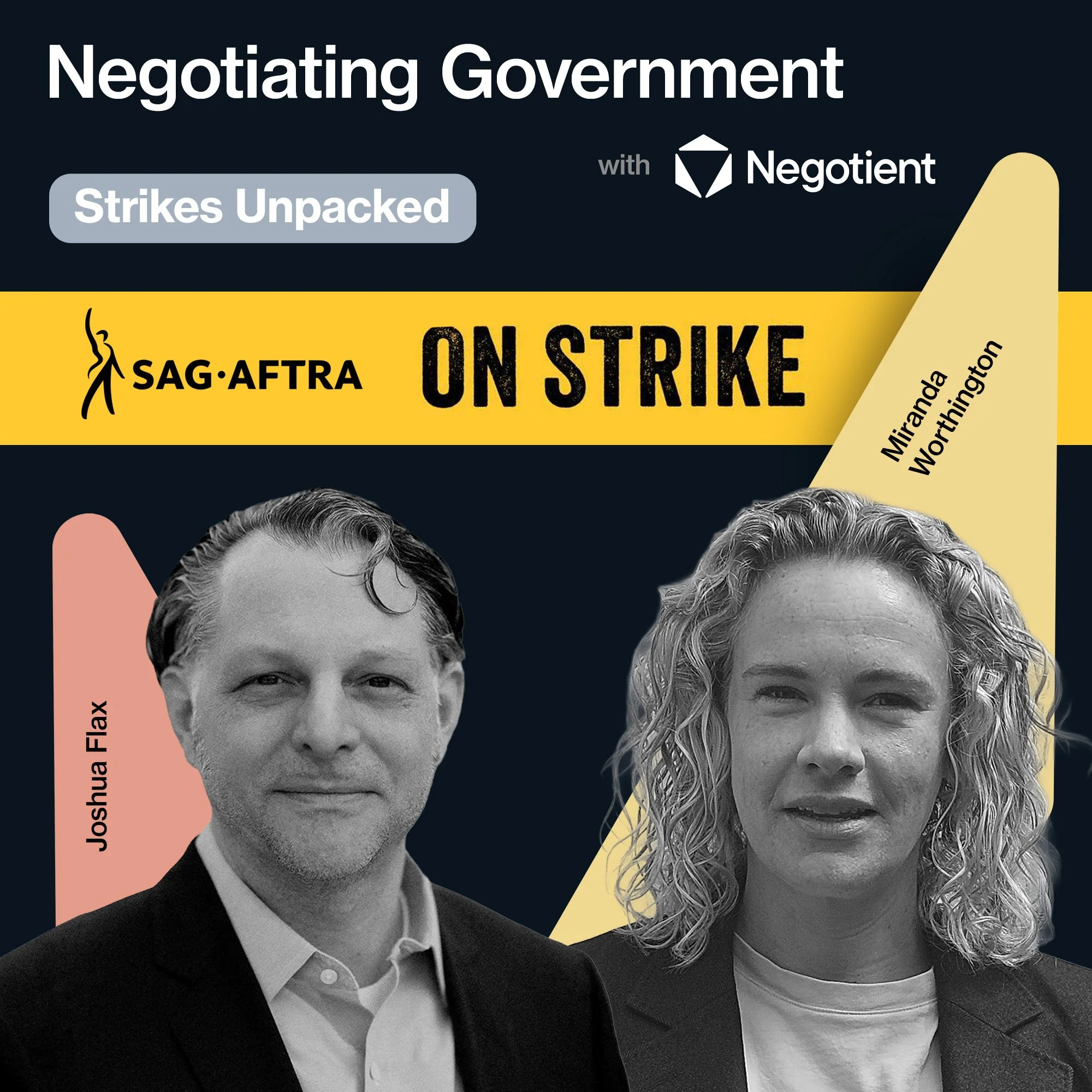
The SAG-AFTRA Strike Explained: AI, Streaming Residuals and Why Strikes Escalate
Why did the 2023 SAG-AFTRA strike last so long — and why do rational negotiators sometimes accept mutually damaging outcomes?
In this episode of Negotiating Government, Miranda Worthington (former Director of Industrial Relations at the UK Department of Health & Social Care) and Josh Flax (former Deputy Director of the US Federal Mediation Service) analyse the SAG-AFTRA strike and what it reveals about modern labour negotiations.
Subscribe:They explore:
The role of AI and digital likeness rights in actors’ contracts
How streaming residuals changed the economics of film and television
Why high-profile strikes escalate despite clear financial losses
How cognitive biases such as the sunk cost fallacy and stop-loss bias distort decision-making
The power of “moves away from the table” and shaping public opinion
How celebrity visibility created leverage in a public negotiation
Using Hollywood as a case study, this episode explains the strategic dynamics behind major industrial disputes — and what negotiators in any sector can learn about leverage, escalation and reputational pressure.
If you want to understand why strikes happen, why they last, and how negotiation psychology shapes outcomes, this episode offers a practical and analytical perspective.
Featured on this episode

Josh Flax
Founding Partner & USA Practice Lead
Josh is an expert in conflict management, negotiation analysis, and government-to-stakeholder regulatory negotiations.
At the US Federal Mediation and Conciliation Service for over 20 years, Josh led mediation teams tackling some of the most difficult public-policy negotiations between government and public stakeholder groups, including national rail negotiations, collective bargaining agreements between employers and unions in multiple sectors, and some of the largest Federal-Tribal negotiations. Josh completed his Federal service in 2023 as one of the two deputy directors leading the agency.
Josh also lectures on negotiation, collective bargaining, mediation, and Indigenous Peoples’ sustainable development at Harvard’s Kennedy School of Government, Harvard Business School, MIT, and Columbia University.

Miranda Worthington
Director
mworthington@negotient.com
Miranda is an expert in public policy, strategy and negotiation.
As the Department of Health of Social Care’s Director for NHS Industrial Relations through the NHS strikes from 2022 to 2024, she was government’s lead policy official and chief negotiator, reaching settlements with unions representing striking workforces. Before this, Miranda held senior roles in HM Treasury, Ministry for Housing, Communities and Local Government and the Department for Education. She has very significant experience in complex and high-profile fiscal policy (such as income tax, welfare reform, and spending reviews). At the Ministry for Housing, she led government programmes related to community regeneration and housing investment.
Miranda excels in building strong teams, and in bringing clarity of thought and sound judgement to help clients solve complex problems.
Transcript
Miranda Worthington 0:04
Hello and welcome to Negotiating Government, the podcast with Negotient. I am Miranda Worthington and I am an associate here with Negotient, and I was previously the Department of Health and Social Care Director of Industrial Relations through the NHS Strikes and I am here with Josh Flax.
Joshua Flax 0:22
Hi, this is Josh Flax. I'm a founding partner here at Negotient. And all of us here have a pretty robust interest in high public impact negotiations, what helps them succeed and what happens when they go wrong. With that in mind, we've been looking at strikes and work stoppages, and this podcast is our second in a series on that subject.
Miranda Worthington 0:45
Yeah. And so we're going to do a short podcast today focusing on a case study, the Screen Actors Guild or SAG After a strike, which lasted from July to November in 2023. And we're going to pull out some of the interesting features of that strike to talk about them.
Joshua Flax 1:02
The other thing we're going to do is ask the question: why do well-intentioned negotiators sometimes pursue potential disaster scenarios, which lose both sides money on the surface when you look at the numbers and the situation? It shouldn't be that way. And yet, it seems to be a feature of industrial labor relations in both the United States, the United Kingdom, and lots of countries with similar industrial labor relations systems. Some conflict at the workplace gets to a point where the parties willingly and voluntarily throw their arms around each other, jump off the cliff together, and light on fire huge cartloads of cash. And this is an interesting topic for us. You know, what would make people voluntarily choose to entertain such a disastrous scenario?
Strike background
Miranda Worthington 1:54
Great. So first, let's cover a little bit of the background on the strike. Josh, can you tell us a little bit about how this strike came about and what it was and what people were striking about?
Joshua Flax 2:07
Sure. This this strike was coming for a long, long time, and everybody could see uh, if not a work stoppage or a strike coming, everybody uh who followed the industry, as well as the general public, could see that the industry had a major problem. And the problem was mainly this in in two parts. Thing one is that the rise of AI and of computer-generated graphics for television and movies, in some ways, seemed to obviate the need for actual actors uh to perform those roles. This is a major problem for actors who are members of the Screen Actors Guild. And additionally, the other problem everyone could see coming was uh what we call the residuals from streaming. And essentially, this means who makes the money every time a television viewer out there accesses the back catalog in Netflix of these and such television shows or movies. And of course, those are copyrighted protected material that they're streaming off of Netflix due to their membership. Who's making the money from all of those additional viewings of that proprietary content?
Miranda Worthington 3:12
And have they made attempts to negotiate before the strike started?
Who are the implicated parties?
Joshua Flax 3:16
Yeah, they started loosely about a year before the tri the strike started. Uh, and of course, there's a long history of trade unionism in Hollywood uh and in this particular industry, not just in Hollywood, obviously in New York and other places where the industry uh has a huge amount of production. And so uh the trade unionism goes back about almost a hundred years by now, in an attempt by the actors to break the old studio system, which was essentially a monopolist employer, and it kept wages down. And so the idea of trade unionism in Hollywood and in the industry in general in the United States, in the UK as well, of having trade unions for the actors, for all of the people involved in creating television and film production in order to try and level the playing field uh with the studios, uh, is is uh a long tradition in that industry.
Miranda Worthington 4:11
And actually, that's a helpful segue to the question I was going to ask you next, which is who is it who is going on strike? I think everyone hears about the very famous people who are striking, Brian Cranston, Jennifer Aniston, and so on. But presumably there's a number of actors who aren't household names who are participating in this.
Joshua Flax 4:29
Yeah, so it's it's in terms of the actors, uh, you've got all your name brand actors who were the biggest draw uh and uh making the most money. They were all walking the picket line with the rest of the union members of the Screen Actors Guild. So are all do all the screen actors uh make that kind of money? And absolutely not. Uh, and Jennifer Aniston and Brian Cranston uh did not need to walk the picket line in order to affect their personal bank balances. This is actually about the many, many thousands of members of the Screen Actors Guild who don't headline television and film uh production. They're all of the uh extras, they're all of the smaller roles, they're all of the other actors that are required to make a scene work and make a production work, but they earn what's called scale. And they earn essentially a base wage that is covered in the collective bargaining agreement. And the old collective bargaining agreement didn't really have robust provision for those actors who are not name brand to share in the benefit of uh continual viewing of content over streaming platforms such as Netflix, Hulu, uh Paramount, and others.
Miranda Worthington 5:41
So was it just actors? What about the wider filmmaking teams?
Joshua Flax 5:47
Yeah, it's a really interesting question, Miranda. Sure, it was just the actors who were technically on strike, but of course, it takes more than actors to make a television or film production uh sing and be successful. Of course, there's uh carpenters and set builders, there's camera operators and sound, microphone and boom operators, makeup artists, caterers, drivers, security movers, you name it. And many of those folks have their own labor union representation, and many of them don't. But the point is, is the actors are just a small percentage of the sheer number of employees and staff that are necessary for overall film production and TV production. So if the actors go out on strike, all of those other types of workers are unable to work.
Miranda Worthington 6:34
So, in a way, there's that collateral damage in the fallout between the actors and the management side.
Joshua Flax 6:42
Yeah, and the collateral damage from this work stoppage from this strike in 2023 was absolutely huge. And uh the costs are estimated in the billions of dollars because all of those people are out of work, not just the actors and not just the production crews that work for the studios. Um, and there was no production possible at all. And remember, some of these productions, even if you just had a three to four month strike, you can't just flip the switch as soon as the strike is over and have production resume the very next day. There were weeks and months more of delay to get all of these productions back up and running and back up on schedule. And so that's produced at least a six to eight month delay in production schedules. And many uh careful viewers have estimated that a lot of television and film release was delayed by up to a year due to this three to four month strike.
Miranda Worthington 7:36
Wow. That's remarkable. And I suppose points back to your opening comment that it seems in nobody's interest for these huge losses that affect actors management side and the other participant, you know, other people involved in the filmmaking process to lose lose out on a lot of revenue.
Joshua Flax 7:58
Yeah, absolutely. And and this is the question that we want to dive into today. What what is going, what is the incentive structure at work or the the cognitive biases at work that actually cause people in a particular industry, in this case a very, very successful industry that was making a huge amount of money? What would cause them to entertain the idea of a work stoppage? You know, why would everybody say, oh, we're willing to go along with a scenario where actually we shut down all of production for three to four months, generating six to eight to twelve months worth of delay in uh in film and television release, which essentially is like taking giant piles of cash and just lighting them on fire.
Miranda Worthington 8:41
And presumably part of the answer to that question is that when the union started considering strike, they thought that they were unlikely to actually go on strike. And when they went on strike, they thought they were unlikely to stay on strike for over a hundred days, which is how long it ended up being. So they felt they they never imagined, or hopefully they never imagined that the losses would be so huge.
Joshua Flax 9:04
Yeah, I mean, I what happens in the collective bargaining universe, especially with this amount of money involved, is that both parties feel like uh they have a fairly righteous position. They may even feel that they have a little bit of movement and they want to see what movement the other party has at the negotiating table to try and resolve uh the conflict. However, the more one party here from the other party, no, we're not willing to do that, whatever that is, the party, both parties might start to think about whether some kind of protracted labor dispute is actually going to achieve their goals. And that was the question that the union leaders for SAG AFTRA had to decide for themselves since they were the ones that initiated the strike. The question was: if they continued negotiations the way they were going, would they make critical gains in the collective bargaining agreement on these two big questions of sharing of uh residual uh uh residuals from streaming? And also who controls the uh computer-generated content and what happens if an actor, uh likeness, voice or both are generated, right? And these were the questions that still needed to be resolved. And the union's initial public position was that negotiations will resolve these questions, and if they don't, uh, or at least resolve them somewhat to our satisfaction, and if they don't, we will consider a work stoppage or a strike.
Miranda Worthington 10:30
I suppose we can't really comment on the specifics of what was going on for both sides in this case, not least because we don't know. But the fact that the strike was so long does suggest that both sid uh perhaps the cognitive bias had crept in and both sides were were digging in um in a way that made it very difficult to reach a conclusion. And I suppose what springs to mind for me is the the sort of sunk cost fallacy where once once you've crossed the Rubicon, you've gone on strike. It becomes actually more difficult to compromise than it would have been before you went on strike. And you you feel like having done that, you need to see greater gains from the negotiation. If both sides feel like that, you can actually move further apart rather than moving closer to an agreement.
Joshua Flax 11:18
Yeah, this goes to our the question of leverage in negotiation, right? And a a small or a media amount of a medium amount of leverage uh that you bring to the negotiating table ideally will be uh uh deployed to try and keep the other party at the table with you and both parties making progress, each party uh making some gains in areas that are important to them, and perhaps making some concessions in other areas that are less important to try and reach agreement. The interesting thing about collective bargaining negotiations is that the parties, in addition to having lower level and medium levels of leverage, they also have a thermonuclear destruct button, which is the work stoppage. And in the United States, that can either be initiated by the union when they go on strike or initiated by the employers when they institute what's called a lockout. Either way, once one side pushes the button, it's like putting a reset on the entire collective bargaining process. Everything has changed, to your point, Miranda, which is excellent. And it doesn't matter up until the work stoppage, whether the parties have been negotiating already for days or months or even years, once one party or the other pushes the destruct button and the work stoppage begins, the dynamics change completely. And your point about this bias uh that starts to creep in is incredibly valuable. In economic terms, what we're talking about here is the sunk cost, which is the amount of money and resources and time and everything that the parties have already sunk into these negotiations and not make the progress that they want. And instead of treating those sunk costs as exactly that as sunk, they start to enter into what we call the sunk cost fallacy, meaning those costs, even though they've already been spent and they've already mounted, start to take center stage. And one party or both parties start to feel like all of the resources they've already spent in these negotiations, in fact, merit just chucking in more resources going in the same direction that eventually they'll recover somehow and get back to a baseline, which of course is not going to happen when the negotiations blow up.
Miranda Worthington 13:44
Yeah. And in fact, often what you need to do in that circumstance is disregard what's already been spent and think purely about what is achievable in the future and how to get the best outcome at the lowest cost.
Leverage and the stop-loss bias
Joshua Flax 13:56
That's exactly right. Let's also not forget to add in our to our discussion something about the leverage. And uh, Miranda, when we've talked about this in the past, you've made the really excellent point that the moment of greatest leverage for parties in a collective bargaining agreement is actually before they blow up the negotiations uh with a work stoppage, not afterward. Do you want to say something more about that?
Miranda Worthington 14:21
Well, uh yeah, that's absolutely right. I think it is most often the case that the incentive, assuming that it's the union about to press the destruct button and go on strike, the moment where management side is most incentivised to do a deal and potentially most likely to be more generous is just before that happens when the threat of it is greatest and the chance of averting it is there. Once it's happened, I think they management side tends to adopt a slightly different attitude and see its its benefits and losses through a different lens. And the level the the threat of strike is no longer there. It's actually happening. And so it feels it feels like something that needs to be avoided less acutely.
Joshua Flax 15:03
I think that's exactly right. And this is the piece of where the stop loss bias comes in after the work stoppage has already started. One or both parties might be more likely to say, oh, well, we've made a bet and it doesn't seem to be working out very well right now, but I'm sure it will one day. So let's keep making bad bets and hold on to our current position. And that dynamic tends to be exacerbated after the work stoppage has been called. One of the things I love about the differences between our two countries separated by a common language, as the old expression goes, is that sometimes you have a really nice way of describing things that isn't widespread in the US. So for example, you've often described a work stoppage as a burning platform. That is to say that once you initiate the work stoppage, you're literally burning up the pl the wooden platform that you yourself are standing on. Um there's no more incentive. There's nothing that's going to keep you secure because you're about to lose uh your perch.
Miranda Worthington 16:04
And actually, I suppose one more thing to say on this is that um being able to negotiate effectively it's not dependent on, but it's certainly helped by having good relations between the parties. And once that destruct button has been pressed, it becomes much more difficult for the parties to have collaborative conversations because there's a degree of whether it's sort of trust or antagon trust being broken or increased antagonism, that is not beneficial.
Joshua Flax 16:36
I know in one of our earlier conversations, you've said it really brilliantly. I'm going to quote you back to you. You said the trick is about looking forward at what you stand to win or lose rather than looking back at what you have already lost. In this case, the employers were not in the dark about what was going to happen if there was a work stoppage, and yet they still failed to improve their offer. So they were going to lose billions of dollars as well if there was a work stoppage. And yet they and yet they carried on that same path.
Miranda Worthington 17:07
Yeah, and I guess there's something there's a few things that spring to mind. One is a sense of people have a very strong sense of fairness, and actually they would rather earn slightly less, but in a context would it feel fair? And so if stopping work to get to the point where an agreement feels like the ongoing arrangement is fair, a lot of people would rather do that, I think. And I also think quite often there's a I suspect that there is an optimism bias when you decide to go down a path that leads to strike and the strike lasts a long time. The optimism bias being a kind of misjudgment of what your counterpart might agree to and how quickly they might agree to it.
Joshua Flax 17:56
That could be. So in other words, the uh the parties see the work stoppage coming and they think, you know what, it might be a short one. We should hold on to our position for another.
Miranda Worthington 18:06
And they think if I if I go once we've gone on strike for a day, the relevant management side will surely see and be persuaded that they need to do X, Y, and Z. And I think I think there is a degree of optimum optimism bias about how that plays out and what what it leads to in terms of action from the counterpart.
Joshua Flax 18:25
Well, that's really interesting because when you think about it that way, it's it goes back to the stop-loss bias that we were talking about and the bad bets. So you've made a bet you made a bad bet, and now there's a work stoppage. You take a look at the situation around you, and you think to yourself, you know what, let's continue the bad bet, because it's it's definitely gonna get better sometime soon. And yet the conflict continues.
Miranda Worthington 18:49
Yeah, and the longer it goes on, I think for some people, and again, not you know, we can't make any comment about specific cases, but there's a degree of bloody-mindedness that's completely human that creeps in. You think, well, I've done it for this long, I'm bloody well gonna stick at it.
Moves away from the table
Joshua Flax 19:05
I think that's exactly right. That's the the bloody-minded mindedness you refer to as the stop-loss bias in action, and people tend to double down on bad bets. Um, if there's an important uh lesson there, uh, it is that uh when you see the bad bets playing out in a disastrous way, for example, in a work stoppage or in some other negotiation context, uh, you need to get help. Uh, you got to reach out for a colleague, friend, advisor, or somebody else who's gonna help you think through this, somebody who's outside of the situation and isn't personally affected.
Miranda Worthington 19:41
Before we finish, there was another element that I think we wanted to touch on briefly, which was what we call in Negotient language moved away from the table. And that was how the union was able to leverage household names celebrities as kind of poster people for the cause. And the celebrities advocated for the union in the public domain, raising the profile of the strike and building public support. That put a lot of pressure on management side. Um, and presumably the interests of the actors represented by the Screen Actors Guild varied hugely. But that wasn't that didn't, you know, they did a good job of of masking that. And it would be interesting to hear a bit, you were saying some interesting things about this when we talked about it earlier, Josh.
Joshua Flax 20:30
Yeah, it's really interesting how the union was able to organise internally. Your point is excellent. The media is gonna cover uh these poster people, you know, uh uh name, brand actors. Uh, you mentioned uh Jennifer Aniston, Brian Cranston. Let me throw in George Clooney and just sort of say, right, anytime any of these folks gets a cup of coffee and forgets their baseball hat and sunglasses, right, the media is gonna take a picture of them and report on it. And certainly when they go and walk the picket line, there's gonna be some really indelible images that are gonna sell clicks and sell papers and sell uh advertising. And so the media really is all over that. And the idea, of course, was, as you point out, to generate pressure on management. What's so interesting about that entire dynamic, of course, is that a computer-generated image of George Clooney versus a computer-generated image of the lowest paid actor in Hollywood had completely different implications for those two people to the point where uh them being even covered by the same collective bargaining agreement is uh really, in some ways, uh wildly uh divergent and hilarious at that level, right? George Clooney is actually going to care quite a lot about the value of his computer-generated image, not just for this production, but for all future productions, professionalism, reputation, craft, public image, all of these things go into making one of these poster people actors at the top of their craft so successful. And of course, so little of that applies to somebody at the bottom of the scale. And yet, SAGAFTRA was able to tell their members that control over your computer-generated image is just as important to every actor in this bargaining unit in this membership, no matter what level of earning or popularity uh you are. And the membership really bought that. And the union leadership should really be credited with uh designing that really skillful internal organising campaign.
Miranda Worthington 22:25
Well, and actually, as you say that, I realise there's credit to be given to the management side here as well, in that the um the studios all agreed to act as one, I believe, which made them a much more powerful negotiating bloc in in a similar way by pooling their interests and acting together.
Joshua Flax 22:44
That's exactly right. And uh, since they've not been declared uh monopolists for doing so, we can expect that in the future they'll continue to uh negotiate as one, as will uh the membership of the union, of course. And uh that's an excellent point.
Conclusion
Miranda Worthington 22:59
Yeah, absolutely agree. And that's probably a great note to wrap up on. Um so thanks, Josh. I always enjoy talking to you about this, and I hope we'll do another one soon. It's always a pleasure, Miranda.
Joshua Flax 23:11
Thanks so much for the time today.
Miranda Worthington 23:13
Goodbye.
Joshua Flax 23:14
Goodbye.