
Podcast > Episode 15
Mining Negotiations: The Stakeholders That Can Make or Break a Deal
Why do mining projects face delays, protests and even cancellation despite securing government approval? And why can stakeholder engagement make the difference between a successful investment and a costly failure?
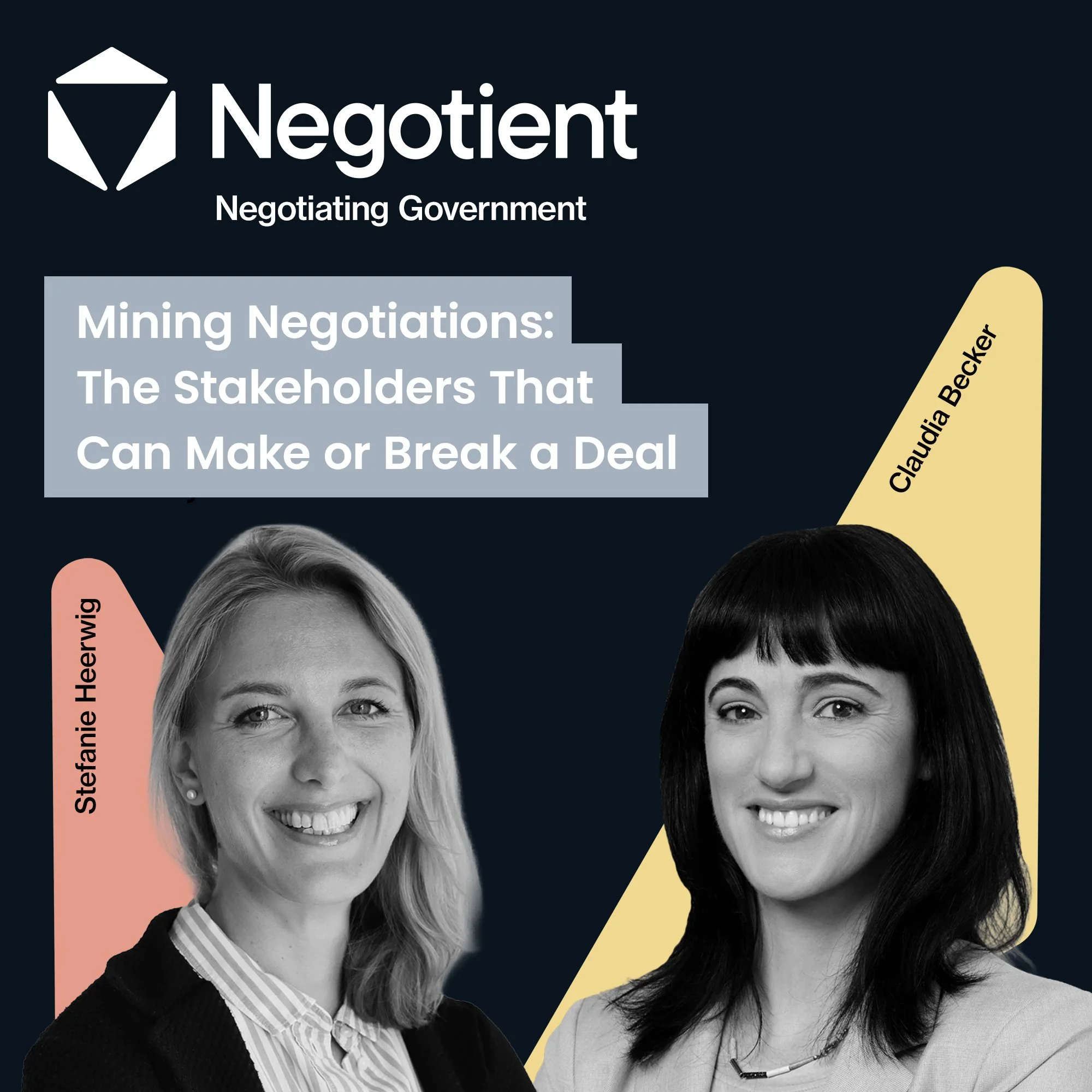
In this episode of Negotiating Government, Stefanie Heerwig is joined by Claudia Becker, Negotient's specialist in responsible sourcing and supply chains, to explore the critical role of third-party stakeholders in mining contract negotiations and why securing a legal licence is only part of the challenge.
Mining projects involve complex negotiations between companies and governments, often requiring substantial capital investment, regulatory approvals and long-term commercial commitments. But communities, Indigenous Peoples, civil society organisations, investors and downstream customers can all influence whether a project ultimately succeeds.
Drawing on Claudia's experience in the automotive industry and responsible mineral sourcing, the discussion examines how local concerns can escalate into international supply-chain risks, affecting manufacturers, investors and businesses far beyond the mining site.
Subscribe:The central lesson is that stakeholder engagement is not separate from negotiation. It is part of the negotiation itself, and it needs to begin long before a contract is signed.
What you'll learn in this episode
Why government approval isn't enough: The crucial difference between a legal licence and the social licence to operate, and why both matter for mining projects.
Who really influences mining negotiations: How local communities, Indigenous Peoples, NGOs, unions, investors and downstream purchasers can affect project outcomes.
Why negotiations begin before formal discussions: How stakeholder expectations and concerns develop during the earliest stages of investment planning.
The importance of Free, Prior and Informed Consent (FPIC): Why Indigenous Peoples' rights and meaningful consultation must be considered before key project decisions are made.
What happens when engagement comes too late: How community opposition can create project delays, financing difficulties, additional costs and reputational damage.
The risks extending across global supply chains: Why mining-related environmental and human rights concerns increasingly affect automotive manufacturers, battery producers and other industrial customers.
Why early engagement creates commercial value: How building trust and understanding stakeholder priorities can preserve flexibility, reduce risks and improve the prospects of reaching a sustainable agreement.
From government approval to community acceptance
The episode examines the Jadar lithium project in Serbia as an example of how local opposition can become a central obstacle to project development, even after substantial technical planning and regulatory engagement.
Stefanie and Claudia discuss why companies that treat stakeholder engagement as an activity to be addressed after securing permits can find themselves facing entrenched opposition at precisely the point when changing course becomes most expensive.
They also consider how responsible sourcing expectations, including those reflected in the EU Batteries Regulation, are strengthening the links between mining operations and global manufacturing supply chains.
For mining companies, investors and businesses involved in major resource projects, the implications extend beyond regulatory compliance. Effective stakeholder engagement can influence investment decisions, access to finance, commercial relationships, reputation and long-term project viability.
A different approach to mining negotiations
Successful mining negotiations require more than agreement between a company and government. They require an understanding of the wider network of stakeholders whose interests, rights and expectations shape whether an investment can proceed.
The discussion highlights why companies should identify these interests early, engage meaningfully with affected communities and incorporate stakeholder perspectives while there is still scope to adapt project plans.
For businesses negotiating complex projects with government, the message is clear: the strongest agreement is not simply one that secures regulatory approval, but one that can retain the confidence of those affected by its implementation.
This is the first episode in a series exploring third-party stakeholder engagement in mining contract negotiations.
In the next episode, Stefanie and Claudia will examine what happens when investment decisions have already been made but community consent or broader stakeholder acceptance is missing — and whether lost trust can be rebuilt.
Featured on this episode

Stefanie Heerwig
Senior Consultant
Stefanie is an expert in extractive‑industry economics and finance, strategic raw‑material management, and responsible sourcing. She brings over a decade of experience advising governments, international organisations, and global companies. Her work includes supporting public–private negotiations for major mining projects across Latin America, Asia, and Africa, underpinned by strong financial‑modelling capabilities and deep expertise in fiscal regimes.
At BMW Group, she served as Senior Expert for Raw Material Strategy & Risk Management, leading ESG‑driven due‑diligence processes, mining‑certification strategies, and global on‑site supplier engagements. She has also advised governments through IISD, GIZ, CONNEX, and ODI on mining‑tax reforms and tax‑audit strengthening. Stefanie is also a former ODI Fellow at the National Revenue Authority of Sierra Leone. She is fluent in French and Spanish.

Claudia Becker
Associate
Claudia has 15 years’ experience in the private sector as well as in non-governmental and international cooperation contexts. She previously worked at the BMW Group, where she shaped sustainability strategies and embedded responsible sourcing practices into corporate decision-making processes. Her expertise spans critical minerals, informed by deep experience in the extractive sector and at the interface between business and communities in complex supply chains.
Claudia focuses on helping companies navigate social and environmental risks, strengthen their social license to operate, and design practical strategies that align business objectives with community expectations. She has led projects across Europe, Africa, and Asia, developing and implementing corporate strategies ranging from human rights due diligence to community engagement. Prior to joining the industry, she worked with municipal authorities on urban development and land governance in Cambodia.
Claudia brings strong facilitation skills and extensive experience engaging corporate teams, industry associations, public institutions, civil society actors, and local communities.
Transcript
Stefanie Heerwig
Hello and welcome to the first episode of our podcast series on third-party stakeholder engagement in mining contract negotiations. My name is Stefanie Heerwig and I work with Negotient. My work focuses on mining contract negotiations, stakeholder engagement, contract analysis, and helping clients, in general, to navigate the increasingly complex landscape surrounding large-scale resource projects.
I'm delighted to be joined today by my colleague Claudia Becker. Claudia, perhaps you could briefly introduce yourself.
Claudia Becker
Thank you, Stefanie. Before joining Negotient, I spent many years in the automotive industry, where I was working on responsible sourcing and supply chains. And in this job, one question kept coming up: Where do the raw materials come from that we need for our products today? For a car, very concretely. Are these responsibly sourced?
And I'm sure our listeners have heard about human rights abuses and environmental harm in mineral supply chains, such as child labour in artisanal cobalt mining in the DR Congo, or water scarcity in the Lithium Triangle, for example. So what I saw is that these problems don't stay at the mine, but media and NGOs report about such cases and gain the interest of investors and customers as well.
So these problems travel really through the entire supply chain, all the way up to the manufacturers who use these minerals.
That's why I'm convinced these impacts are best addressed early. So today, my work with Negotient focuses on exactly that: helping companies understand the human rights and environmental risks of their projects and to engage with local communities on a fair footing.
Stefanie Heerwig
Thank you, Claudia. And thank you for joining us. That's exactly why I'm excited to have this conversation with you today. Because stakeholder engagement is often viewed as community relations issues, or something in that area. But it's normally, in reality, the implications that go far beyond the mine gate.
So just the fact that I'm talking with you, somebody who has worked for many years in the automotive industry, makes somebody think, like, what does that have to do with mining, actually? But that's where the point comes.
And therefore, I wanted to start off with some questions when we talk about stakeholder or third-party stakeholder engagement. So let's start with the basics. When we talk about third-party stakeholders and mining negotiations, who are we actually talking about?
Claudia Becker
Well, we're talking about groups that are usually not considered the main parties at the negotiation table, but those parties increasingly decide whether a project succeeds or fails.
So the first group are the communities living right next to the mine. They are the ones who live with the consequences, and they speak up or protest when mining activities, for example, damage their environment, their water, their land.
And then Indigenous Peoples are a special case. They are not just stakeholders; they are even rights holders. So their rights are recognised by the United Nations and, in many countries, already in national law. So Canada, for example, the government and companies have a legal duty to consult those First Nations. And their consent to a project is indeed needed.
Why is this important? Because, according to research from the University of Queensland, more than half of the mining projects for the energy transition minerals that we need to decarbonise our economy are located on or near those Indigenous Peoples' lands.
Stefanie Heerwig
And third-party stakeholders extend beyond communities, Indigenous groups as well.
Claudia Becker
Yes, very much so. So third-party stakeholders also include local, national or even international civil society organisations, NGOs, but also worker representatives and unions, academics, increasingly also investors and downstream purchasers.
So one thing that has changed in recent years is that those local concerns, they no longer stay local. So communities are better connected than ever, so with each other, but also with these civil society organisations and with the media.
When something goes wrong at a mine, this story really travels, and often along the whole supply chain, all the way up to the companies that buy the material and want to produce a car out of it. And this international attention creates real pressure, so governments, investors, but also on the companies themselves.
A local protest can no longer simply be waited out, but it has to be taken seriously, and actually the earlier the better, I would say.
Stefanie Heerwig
So now there's a good question. When we talk about Negotient, we focus on negotiations. Why are negotiations involved in working with third-party stakeholders? This is, like, the next question I would like to talk about.
And this is, like, something that we notice often in our work, is that, like, making this link is a bit difficult for our clients. Our clients don't realise they're already in a negotiation.
What do you think is this big misunderstanding about?
Claudia Becker
From my perspective, this misunderstanding is that a negotiation starts when a company sits down with government officials, for example, to discuss the mining agreement or the specific licence.
I would say negotiations begin much earlier. I would argue that negotiation starts at the point where a company begins evaluating whether it wants to invest in a specific project.
Stefanie Heerwig
So even before a formal investment decision is made.
Claudia Becker
Exactly. So at that stage, communities, local leaders, also civil society organisations or government officials, they already form expectations and opinions.
So the investor may not see these interactions as negotiations, but indeed stakeholders are already evaluating the project's potential benefits, but also the impacts, for example, on the environment. And therefore, they also evaluate ultimately its legitimacy.
Stefanie Heerwig
So from your perspective, stakeholder engagement is not something that happens after a permit is secured.
Claudia Becker
No, no, no. I would say quite the opposite. In an ideal scenario, this engagement begins early enough so that stakeholders concerned, the community living around a mining site, and their local knowledge can still be reflected in the project plan.
So that is also for the mining company when there is still room to adapt and when changes are also still affordable.
As we heard earlier, those Indigenous Peoples are rights holders. And that is where the concept of this so-called Free, Prior and Informed Consent comes into play.
And this means that communities have to be asked before a first decision is made. And they have to be asked without pressure, with full information, and this information in language that they understand, and with a genuine opportunity to give or even withhold their consent.
And prior, I would say, is the keyword. This consent cannot be sought once the permit is already in the hand of the mining company.
Stefanie Heerwig
Unfortunately, that's not always how things happen in practice. What are the risks when engagement comes too late, in your opinion?
Claudia Becker
Hmm. I would say the challenge, for example, is that a company can obtain licences, permits or government approvals. But if it's still lacking this broader acceptance, and that's the so-called social licence to operate from the local communities and other stakeholders.
So the company is already at the point where significant investments have already been made. So the company has committed capital, has a timeline, has negotiated financing and possibly even signed downstream supply arrangements.
And there is really little room for adaptation in case an opposition emerges, or this results actually in enormous costs if you see the local community protesting against the mining site.
Stefanie Heerwig
There are several mining projects that illustrate exactly this example. What can we think about when we talk about those examples?
Claudia Becker
I mean, a well-known example very recently, for example, is the Jadar lithium project in Serbia that had to stop because of local opposition.
So really this stakeholder opposition that arises due to lacking public acceptance became the central issue, despite there was a lot of prior technical planning and also a legal licence already being in place.
So these examples really remind us that a legal licence and the so-called social licence to operate are two very different things.
Stefanie Heerwig
And often much more difficult to obtain once positions have become entrenched, right?
Claudia Becker
Yes, indeed. So building trust early enough is usually far easier and then significantly less expensive than trying to rebuild it later.
Stefanie Heerwig
So why should companies care? Many people immediately think about project delays and disruptions. Those are obviously important, but what other reasons should motivate a company to pay attention to stakeholder engagement right from the start?
Claudia Becker
Hmm. Yeah, right from the start. I mean, mining projects involve enormous capital investments, and therefore every month or even every day of delay is expensive.
So delays indeed are an important factor. And this delay doesn't stay at the mine either. So when a project stalls or, for example, when a mine has to shut down, even supply chains are interrupted.
And that's very painful on the one hand for the mining company, but also for the manufacturer further downstream who depends on these minerals.
The implications go further still. So opposition can make financing and insurance more difficult, security costs rise, or, for example, they might even close doors for future opportunities.
From my own professional background, there is one factor that I think is most often underestimated, and that's reputation.
Stefanie Heerwig
Why reputation specifically?
Claudia Becker
Because those reputational risks don't remain local, as I've been underlining, yeah, a couple of times already.
So those mining companies operate within complex and global supply chains. And automotive manufacturers, battery producers, other downstream customers, they increasingly expect—are increasingly expected—to demonstrate responsible sourcing practices.
And those practices are now also being written into law, for example, in the EU Batteries Regulation.
So if a mine becomes associated with infringements of Indigenous Peoples' rights or with environmental damage, that doesn't stay at the mine. It travels through the supply chain and lands on the desks of car manufacturers.
So what starts as this local issue becomes a corporate issue far away from the mining site.
Stefanie Heerwig
So community protests at a mine can eventually become a broader-level discussion elsewhere.
Claudia Becker
Exactly. I had a former colleague of mine who used to say, "A good day is when the board doesn't call."
And what he refers to are calls from senior leadership that are rarely good news. And they were usually tied to a critical story in the media, an NGO report, or an investor asking difficult questions.
So good stakeholder engagement means these issues are identified and dealt with long before they reach the boardroom.
Stefanie Heerwig
Is there one key message listeners should take away from today's discussion? What would it be?
Claudia Becker
That's a good question. Well, stakeholder engagement, I would say, is not an activity that happens after negotiations. So it should be part of the negotiation itself. And it starts long before anyone signs a contract.
And from my experience, the companies that recognise this early generally have more options on the table. They build stronger relationships with the local communities.
And they're better positioned to develop projects that are both commercially successful, but also accepted by the communities around them.
Stefanie Heerwig
This is a perfect place to conclude our first episode. Thank you, Claudia, for joining us.
The next episode will focus on the more difficult and unfortunately common reality: the investment decision has been made, but consent or broader stakeholder acceptance is missing.
How do you regain that trust? Can you ever regain that trust?
Claudia, thank you again and looking forward to our next episode.
Claudia Becker
Thank you, Stefanie. And yeah, I'm also looking forward to it.