
Podcast > Episode 07
How the UK Budget Affects Business: Pharma, Energy, Oil and Regional Growth Strategy
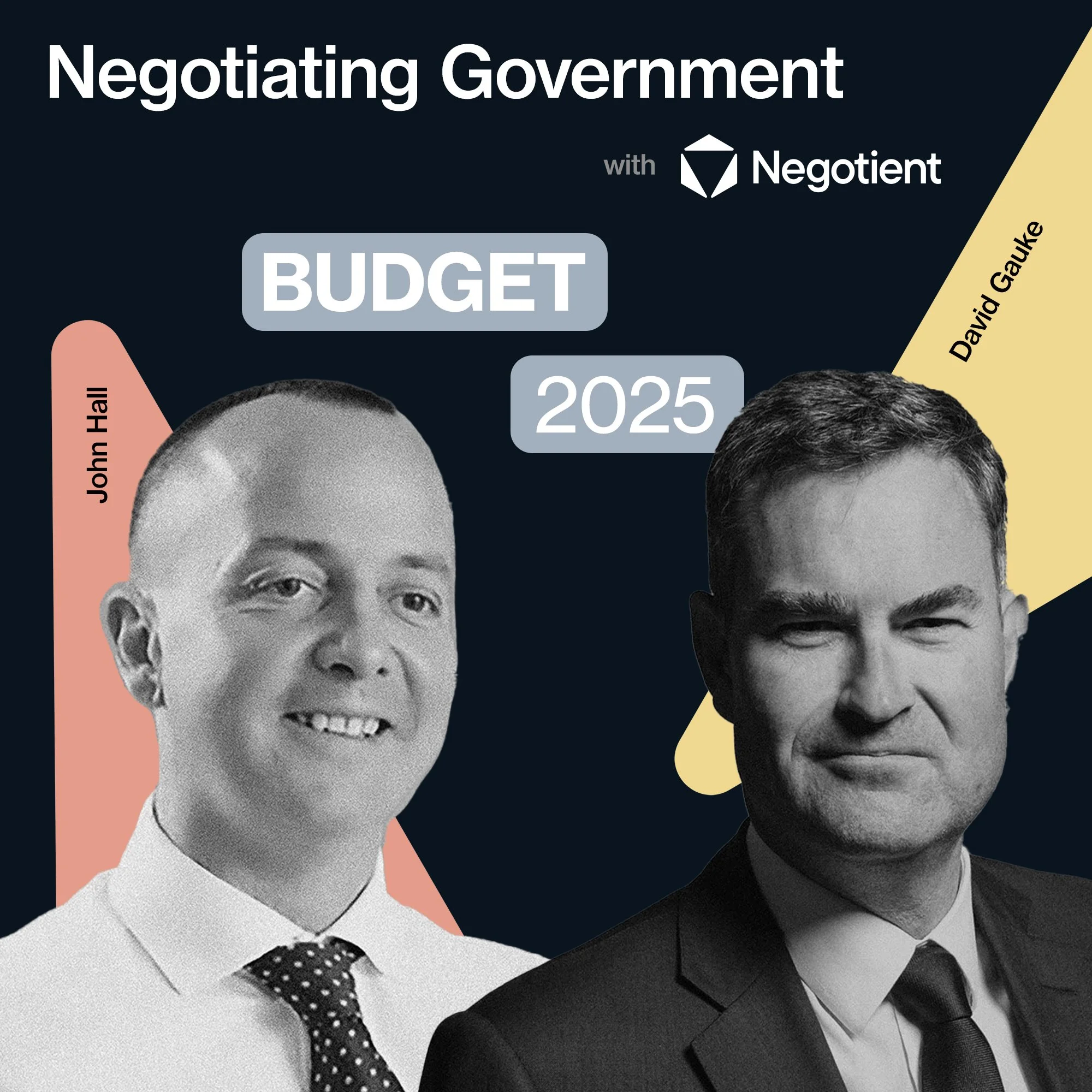
Inside the UK Budget 2025: Tax Rises, the Fingleton Review and What It Means for Business
What does the UK Budget 2025 really mean for businesses negotiating with government?
In this episode of Negotiating Government, former Treasury official John Hall and former Chief Secretary to the Treasury David Gauke analyse the November 2025 UK Budget from an insider’s perspective — focusing on what matters most for the private sector.
Subscribe:They examine:
Why the Budget prioritised fiscal repair over economic growth
What the Fingleton Review reveals about regulatory reform and infrastructure delivery
Whether the government’s fiscal headroom strategy is sustainable
The pressure points facing sectors such as NHS pharmaceuticals and energy
Whether “temporary” taxes like the Energy Profits Levy ever truly remain temporary
The strategic importance of the new Local Growth Fund and mayoral investment powers
Despite significant tax measures, the Budget left many business leaders questioning the UK’s growth strategy. This episode explores how fiscal policy, regulatory reform and political constraints shape the environment for companies engaging with government.
If you operate in a regulated sector or face sector-specific tax risk, this episode explains how to interpret Budget signals — and how to respond strategically.
Featured on this episode

David Gauke
Chair
Negotient’s chair is David Gauke, a former Member of Parliament and Cabinet minister.
As Chief Secretary to the Treasury, David negotiated public spending settlements with Government departments and devolved administrations, led public sector pay policy, and engaged with policy issues including infrastructure investment, health reform, and defence procurement.
David is a City solicitor by background. He appears frequently in the media as a political commentator, is a columnist with the New Statesman and ConservativeHome, and edited the book The Case for the Centre Right.

John Hall
Associate
John provides strategic advice to public, private and not-for-profit organisations in the UK and internationally.
John is a former senior civil servant with 30 years’ experience in public spending, strategy, and public finances. He was strategy director in the Department of Health and director of economics at the regulator for NHS Foundation Trusts. As deputy director of public spending in HM Treasury he negotiated multiple spending reviews, infrastructure packages, and policy reforms.
John has a strong track record in building effective teams, coaching professionals to higher performance, and helping teams and organisations reorientate themselves to meet the challenges of the future.
Transcript
David Gauke
Hello, this is David Gauke, Chair of Negotient and former Treasury Minister. Welcome to the latest edition of our Negotiating Government podcast. I am delighted once again to be joined by John Hall, former Treasury official, as we pick over another fiscal event, this time the November 2025 Budget delivered by Rachel Reeves. It was a much anticipated Budget, it would be fair to say.
We are going to talk about what it means for those who are negotiating with government. So John, welcome. What is your high level assessment of what the Chancellor was trying to achieve in her Budget on 26 November?
John Hall
It is an interesting one, David. I would make three broad comments.
First, by any measure, this was a big Budget. It increases taxes by £26 billion and, coming on top of a £32 billion hike last year, this sets the government on course to have the highest tax raising Parliament in my lifetime. Taken together with the last Parliament, the UK is moving from a tax burden of around 33 to 34 percent of GDP, where it has been for decades, to about 38 percent by the end of this one. That is a shift from a relatively low tax European economy to a medium to high tax one. A five percent increase in the national take of income for public spending and taxation is unprecedented and represents a huge shift in the balance between the public and private sectors.
Second, it was big in terms of the sheer number of announcements. The IFS calculated that there were 75 new measures in this Budget. By any stretch of the imagination, this was substantial.
Despite that, much of the discussion before and after the Budget was dominated by process rather than substance. Attention focused on the dynamics between the Treasury and the OBR, on expectation management, and on whether the Chancellor had been fully candid. That noise has drowned out both the significance of the Budget and what the Chancellor was trying to achieve.
Which brings me to my third point. For such a big Budget, it was oddly underwhelming. It is quite hard to identify what it was actually for. When I worked in the Treasury, Chancellors were usually very clear about the purpose of a Budget and which group it was intended to help.
Here, Rachel Reeves appeared to have two audiences in mind. First, the bond markets, where she needed to demonstrate adherence to her so called ironclad fiscal rules to reassure investors and help bring interest rates down over the medium term. Second, Labour backbenchers, who needed to be reassured that she would introduce policies they could support.
That leaves the wider question of whether it was good for Britain. Ultimately, this was a fiscal repair Budget. Interestingly, that repair was not required because of dramatic changes in the underlying OBR forecast. In fact, those changes were relatively modest. The problem was that Rachel Reeves had left herself too little headroom against the fiscal rules in last year’s Budget and has now been caught by events rather than shaping them.
What it was not was a Budget for economic growth, and that worries me. UK productivity forecasts have been downgraded from 1.3 percent to 1 percent, against a backdrop where productivity has barely grown at all in the past three years. Further downgrades are entirely possible. When I was in the Treasury, we aimed to raise trend growth from around 2.5 percent to 3 percent. Over this Parliament, growth is forecast at around 1.5 percent.
The OBR expects barely any increase in household disposable income by the end of the Parliament. That would make this the second worst Parliament on record, with only one worse, which coincided with a global pandemic.
This Budget did nothing to raise growth. In fact, growth forecasts were downgraded. The government did take steps to mitigate cost of living pressures, but inflation is now forecast to be higher and stickier than it was in March. So while this was a huge Budget, obscured by noise about process, the fundamental question remains whether it was what Britain needed, or simply a survival Budget to get past the bond markets and Labour backbenchers.
David Gauke
I think that is a fair characterisation. The Chancellor faced two immediate risks: a bond market meltdown and a political meltdown among Labour MPs. The audiences that mattered were not the general public or even the business community, but the bond markets, which is why headroom had to increase.
Most of us would agree that £9.9 billion of headroom was far too low, and we have probably criticised that before. Labour MPs did seem satisfied. Expectation management played a role. The fact that the basic rate of income tax did not rise brought a sigh of relief, while higher welfare spending was positively welcomed.
Much of this centred on reversing cuts to winter fuel payments and disability benefits, and abolishing the two child benefit cap. These were very Labour friendly measures. One theory is that the absence of supply side, pro growth measures reflects concern that they would be controversial with Labour MPs.
What struck me was that, despite the Budget being light on growth, we saw pro business announcements immediately afterwards. The government stepped back from a day one right to claim unfair dismissal in the Employment Rights Bill, and the Prime Minister strongly endorsed the Fingleton review on nuclear power, highlighting excessive regulatory costs.
Those could have been reframed as central, pro growth Budget measures. I suspect politics explains why they were not. But taken together, there is perhaps more cause for optimism than the Budget day itself suggested. Would you agree?
John Hall
I am a strong supporter of avoiding Budgets that spray out dozens of announcements which never see daylight. Important issues like the Fingleton review deserve proper airtime.
What struck me most about that review was how familiar its themes were. The preference for bespoke, gold plated designs over modular solutions, multiple regulators with overlapping responsibilities, and a risk averse culture that leads not to good regulation but to bad regulation that imposes costs and delays without delivering benefits.
While I am not an expert on nuclear, what worried me was that if you removed references to small modular reactors, the analysis would apply to almost every major infrastructure sector in the UK, from hospitals to HS2. The problems feel systemic.
David Gauke
That suggests an opportunity for industries negotiating with government. They can point to the Fingleton review and argue that the same issues apply to their sector, and that lessons learned in nuclear could provide a blueprint for wider reform.
John Hall
I think that is exactly right. Many sectors face the same structural challenges. One takeaway from post Budget announcements is that the government is committed to growth, even if that was not front and centre in the Budget itself.
The UK faces a prolonged period of low growth and stagnant living standards. Unless that is addressed, fiscal repair alone will not solve our problems. While there are positives, such as sticking to the corporation tax roadmap and maintaining historically high public sector capital investment, growth ultimately depends on decisions made by individual businesses in individual sectors.
That creates an opportunity for business to engage government on sector specific barriers to growth, using reports like Fingleton as evidence that these are systemic issues, not special pleading.
David Gauke
That seems fair. Given the £26 billion tax rise, the government could have taken easier but more growth damaging options. They largely avoided hitting internationally mobile businesses, perhaps because they did so last year. That suggests growth is at least on their radar.
Still, the absence of growth as a clear theme in the Budget is striking and may reflect internal political constraints. That tells its own story.
One feature of the Budget was the scale of spending pressures identified by the OBR, including special educational needs, the NHS, pharmaceuticals, and asylum accommodation. What stood out to you about those pressures and the opportunities they create?
John Hall
I have been surprised by how little attention those pressures have received. Even before the Budget, around £20 billion of additional spending pressures had been identified without any policy change. These consumed much of the increased revenue from inflation and growth composition effects that were largely missed in pre Budget commentary.
Some pressures relate to higher debt interest, others to rising benefit caseloads, particularly health related benefits. SEND spending is rising by 14 percent and would bankrupt local authorities without central government intervention. There are also pressures on asylum accommodation and the NHS.
Savings assumed from reducing hotel use for asylum seekers have not materialised, while NHS drug spending has risen following a deal with the pharmaceutical industry that is already being reopened. The OBR has reflected these pressures by assuming departments will fully spend their allocations rather than underspend.
David Gauke
On pharmaceuticals, though, there is a sustainability question. Disinvestment risks and delayed drug launches were becoming serious issues. It remains a difficult balance. The oil and gas sector raises similar concerns, with the windfall tax creating ongoing regulatory uncertainty.
John Hall
Both cases highlight the temptation for governments to target sectors that are politically convenient in the short term. In pharmaceuticals, we may have forgotten that life sciences is one of the UK’s genuinely world class industries. In oil and gas, a temporary windfall tax introduced during an energy crisis has now been extended to 2030.
Temporary measures have a habit of becoming permanent. Fuel duty freezes are another example. The lesson for industry is simple: never believe the word temporary.
David Gauke
Before we finish, can I ask about the Local Growth Fund and increased funding for mayoral authorities? That could be significant for some listeners.
John Hall
Regional inequality is something the UK has never cracked. National government struggles to coordinate cross departmental solutions, whereas mayoral authorities focused on place rather than function may be better placed to broker integrated deals.
David Gauke
Finally, how credible are the longer term spending plans, particularly as we approach an election?
John Hall
Rachel Reeves deserves credit for increasing headroom from £10 billion to £22 billion. That was politically difficult. But it remains low by historical standards. The OBR gives a 59 percent chance of meeting the rule, better than before, but not robust.
Spending rises during the review period, then flatlines in real terms in the year of fiscal reckoning, outside the review. That implies implausibly deep cuts unless commitments are abandoned. Three quarters of tax rises are also backloaded to after April 2029, likely an election year. That strains credibility.
In short, the repair is real but backloaded. It feels like the St Augustine prayer: Lord, make me virtuous, but not yet.
David Gauke
That suggests challenging Budgets ahead unless something unexpected boosts productivity. Anyone dealing with government will need to bear that in mind.
John, thank you once again. And thanks to our listeners. You can find previous episodes on the Negotient website, and we will be back with further Negotiating Government podcasts in the future. Thanks for listening.