
Podcast > Episode 11
How Governments Co-ordinate Investor-State Negotiations and Disputes
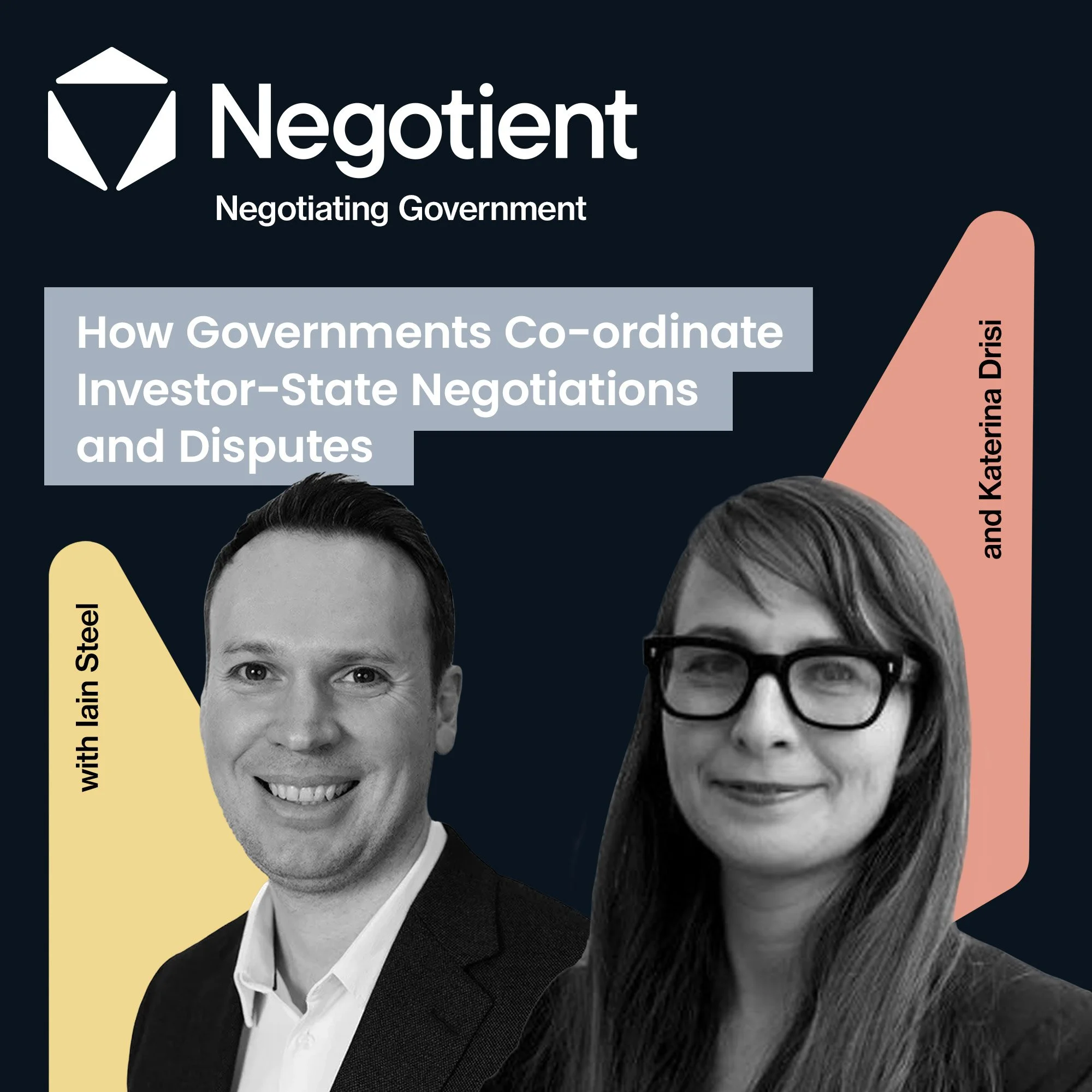
What makes the difference between a successful investor-state negotiation and an expensive international dispute?
In this episode of Negotiating Government, Negotient founding partner Iain Steel is joined by Katerina Drisi of ProSovereign Global to explore the often-overlooked challenge at the heart of major government investment deals: internal coordination.
Subscribe:How Governments Co-ordinate Investor-State Negotiations and Disputes
What makes the difference between a successful investor-state negotiation and an expensive international dispute?
In this episode of Negotiating Government, Negotient founding partner Iain Steel is joined by Katerina Drisi of ProSovereign Global to explore the often-overlooked challenge at the heart of major government investment deals: internal coordination.
Investor-state negotiations involve far more than a government department and a multinational investor. Whether the project concerns mining, energy, natural resources, infrastructure or a public-private partnership, governments must align the interests of finance, legal, labour, environment, investment and sector ministries — while retaining political support at the highest level.
Iain and Katerina discuss how governments can build effective negotiating teams, manage competing priorities across ministries and avoid the inconsistent decisions that can trigger investor claims for unfair or discriminatory treatment. They also examine the practical realities of investor-state arbitration, from gathering evidence and managing legal counsel to establishing clear processes when a claim is received.
The conversation explores why negotiation success depends on more than getting a contract signed. Strong implementation, structured handovers, realistic contractual obligations and clear accountability are all essential to preventing disputes later.
Drawing on experience advising governments across international investment projects, Iain and Katerina share practical lessons on:
Building cross-government teams for investor-state negotiations
Managing negotiation strategy, political escalation and back channels
Preventing disputes through consistent administrative processes
Improving handover from deal negotiation to implementation
Designing contracts that can be delivered within real institutional capacity
Strengthening government readiness for international arbitration
For government leaders, public-sector negotiators, investors, legal advisers and anyone involved in international investment, this episode offers a practical guide to negotiating better outcomes — and reducing the risk of disputes before they begin.
Featured on this episode

Iain Steel
Founding Partner
Iain is an expert in negotiation strategy, economics, and finance.
Iain has over 15 years’ experience in complex public-private negotiations and public policy. He has advised clients in Africa, Asia, Latin America and the Pacific on public-private negotiations for multibillion-dollar investments in energy, transport, agriculture, and extractives projects. Iain worked previously as a senior policy advisor at HM Treasury, where he led several high-profile policy reforms; as an expert for the International Monetary Fund on extractive industry tax and financial modelling; and as resident advisor to the Ministry of Finance of Liberia, where he advised on negotiations for concession agreements in agriculture and mining. He is also the founder of Econias, a consultancy that supports developing countries to negotiate better deals for mining projects.
Iain combines strong analytical rigour with clear communication, to help clients maximise value in negotiations.

Katerina Drisi
CEO/Founder
ProSovereign Global
Sovereign low and middle income markets expert with over fifteen years of experience in launching and implementing programs of pro bono legal and sustainability support to governments and other stakeholders, including impact funds, and civil society organizations in Low and Middle Income Countries (LMICs).
Background in capacity building, partnership building, fundraising and business development, project management, and stakeholder engagement in a range of economic sectors, oil & gas, mining, infrastructure, energy & renewables, financial services, health, agriculture, energy transition, climate change.
Former common law and civil law trained attorney, specialized in public procurement and government contracts for large infrastructure and energy projects.
Transcript
Iain Steel
Welcome back to the Negotiating Government podcast, brought to you by Negotient. My name is Iain Steel and I’m joined today by Katerina Drisi. Hi, Katerina.
Katerina Drisi
Hi, Iain. Thank you for the invitation.
Iain Steel
Thank you for joining us. We are going to talk today about internal government coordination in investor-state negotiations and disputes. But before we get into that, in preparing for this podcast, we made an interesting discovery: neither of us has ever listened to a podcast before.
Katerina Drisi
Which is exciting, because that means our podcast will be the first one we will listen to, Iain.
Iain Steel
And before we listen to it, we’ll be two of the only people who will have recorded more podcasts than they’ve ever listened to.
Katerina Drisi
Correct.
Iain Steel
So let’s kick off with some introductions. I am one of the founding partners at Negotient. We are a boutique consultancy that advises on public-private negotiations.
My background is in economics. I spent the first 10 years or so of my career in the UK Treasury, advising on a number of different tax policy and public spending roles. Then, in the second decade or so of my career, I have been advising mostly developing-country governments in investor-state negotiations with multinationals for big investment projects in areas such as mining, energy and infrastructure.
Katerina Drisi
The launch of ProSovereign Global was the culmination of many years of experience working in government or representing and supporting governments, particularly in low- and middle-income countries. Just like you, Iain, I started my career as a lawyer and as a senior adviser to the Ministry of Finance in Greece, where I specialised in public procurement and government contracts. For more than 15 years, I have been working at the intersection of law and global development, with a particular focus on sovereigns.
Iain Steel
We have both been very fortunate to work with a range of governments in lots of different countries, and I’m really looking forward to getting stuck into the topic with you and sharing our experiences of government coordination in investor-state negotiations and disputes.
Just before we get into that, we should say a little more about what we mean when we say investor-state negotiations and disputes.
These are negotiations that take place between governments, so the state, and usually foreign investors, often multinational corporations. They are used very often for big investment projects in mining and natural resources, the energy sector, or big public-private partnerships for infrastructure.
What typically happens is that the investor and the state negotiate the framework for that investment, including the land rights that will be given to the investor to develop the project, the timeframe for developing the project, the financial and commercial terms that will apply, and the legal framework, including, very often, dispute resolution.
Maybe you could tell us a bit about the dispute resolution side of this.
Katerina Drisi
Yes, absolutely. Dispute resolution is an unavoidable challenge that you always need to navigate. First, you need to navigate not getting there. Then, once you are there, you need to navigate it so that it has the least possible negative impact on your country and your government.
Investment disputes generally are conflicts between foreign investors and host-state governments arising from an investment. Common causes of these investment disputes can include expropriation, when the government takes or effectively seizes an investment, for example by nationalising a mine or cancelling a licence.
Another common cause is unfair or unequal treatment, when an investor claims that they have been treated differently from other investors, or when there are inconsistent or arbitrary decisions on behalf of the administration. It could be a breach of contract, when the government allegedly has not respected the terms of an agreement; regulatory changes, when new laws or policies cause harm or damage to the investment; or a failure to provide protection, when the government does not protect the investment from harm or damage.
Most of these dispute resolution cases are now resolved through international arbitration. That could be ad hoc, meaning they are not adjudicated with the help of an institution, or institutional, where an institution facilitates the conduct of the arbitration proceedings. Such arbitration institutions can include the International Centre for Settlement of Investment Disputes, or ICSID, the London Court of International Arbitration, and a number of highly qualified regional arbitration centres that governments should also be aware of.
Iain Steel
I think the first thing I would say about investor-state negotiations is that the state side of that is actually a set of complicated interests across the whole of society. The state negotiating team needs to be able to reflect that broader set of interests.
The way that is typically done is that the team will comprise members from different line ministries within government, who have different interests and objectives.
If you take, for example, a mining-sector negotiation, which we have worked on quite a lot over the past 10 years, usually the negotiation would be led by either the investment commission or the mining-sector ministry. The team of negotiators would have representatives from the Ministry of Finance, because there is a big fiscal impact from mining negotiations. It would have the Ministry of Labour for jobs, the Ministry of Environment because of the environmental impacts of mining, and so on and so forth.
A critical thing for governments to get right in these negotiations, and to negotiate effectively with investors, is to manage the internal negotiation first. Understand how the project being negotiated impacts on those different interests. Identify what your interests are as a government team and what conflicts or trade-offs you might have to make.
Katerina Drisi
That’s excellent. Iain, where have you seen this in practice? Do you see negotiations mostly being conducted through individual line ministries, or do you see a trend of governments putting together negotiation teams that represent these different interests and points of view within government?
Iain Steel
Typically, it would be a negotiating team, and it would be an intentional decision by government to set it up that way. Sometimes that is set out in law.
To give you the example of Liberia, which is where I cut my teeth in this sort of work 10 or 15 years ago, their law mandates that, when they are negotiating with an international investor, the president will create what they call an inter-ministerial concessions committee.
That committee will have deputy ministers or ministers from different line agencies, depending on the sector. Again, if it is a mining-sector investment, you would have the Ministry of Mines and Energy, the National Investment Commission, which is basically the secretariat of the negotiating team, the Ministry of Finance, the Ministry of Environment, the Ministry of Labour, and so on and so forth. It is a conscious decision to set a team of different ministers or different departments to negotiate on behalf of government as a whole.
The deal that they negotiate with the investor would then be ratified by the president and the National Assembly, and passed into law.
Katerina Drisi
Yes. And let’s not forget that the same ministries and agencies sitting at the negotiating table will also be the implementing agencies afterwards. They will take the contract and make sure that it is implemented within their respective ministries. So it is absolutely critical that their views and insights are taken into consideration during the negotiation stage.
Iain Steel
So, in a dispute, how would you set up the government team? Is it a single government entity that leads that, or are lots of different ministries involved in that process as well? How is that done effectively?
Katerina Drisi
Well, it depends. Usually, it is the Ministry of Justice or Legal Affairs that leads the dispute resolution process.
But depending on where the arbitration is and which ministry or agency is at the root of the dispute, one of the main things that the key central agency, such as the Ministry of Legal Affairs, does is to assess the underlying facts of the claim. This is where there needs to be substantial coordination within government, in order to assess what exactly happened, what documents are available, what conversations have taken place, and where we are in terms of implementation or non-implementation across other ministries and agencies.
Usually, responsibility for dispute resolution lies with one entity, either the Attorney General’s Office or the Ministry of Legal Affairs. In some governments, such as Greece, which is a civil-law system, there is a specialised entity called the Council of State, where the lawyers who defend the government and the country are based.
Iain Steel
When you are advising governments in dispute, what do you advise them to do on the internal government side? How do you advise them to set this up? What does best practice look like? Where have you seen this done well, and what does it look like where it has not been done well?
Katerina Drisi
Well, Iain, you are raising quite a considerable challenge that we see in dispute resolution, which I believe is also the case in contract negotiations. That is coordination across government, and it can pose a core risk in dispute resolution.
One of the biggest challenges we see is a lack of consistency and coordination within government. This can affect or trigger a dispute in two ways. First, if there are inconsistent administrative practices within government, that could potentially give rise to investors’ claims of discriminatory behaviour or unfair or inequitable treatment.
For this reason, every government needs to establish some process regularity, even when it deviates. When you deviate, you need to demonstrate that a consistent process has been followed. It is very important for government to apply rules consistently across all agencies and ministries, make sure that the treatment of investors is the same, and ensure that agencies do not make arbitrary decisions.
A second issue is when contractual obligations are not applied evenly across all levels of government. In that case, the liability sits with central government, as we discussed.
Some suggestions for alleviating this challenge, and keeping everyone on the same page about contractual obligations, include a proper handover of the contract to implementing agencies and consistent, transparent processes within government. There should be a clear administrative approach to handling investors in a predictable and consistent manner. If standard processes are followed consistently and predictably across all levels of government, it becomes much harder for an investor to claim and prove unfair or discriminatory treatment.
Another practical suggestion is to create internal guidelines for what happens when a state receives a claim. What are the immediate steps? That can improve the chances of de-escalating a potential dispute and set the state up for success if it ends up needing to defend itself in arbitration.
There are examples of countries that initially have not been the most successful respondent states in dispute resolution. Chile is one example. It has faced multiple investor claims in sectors such as energy and infrastructure, but is generally regarded as one of the most successful respondent states because it has stable and transparent regulatory frameworks, well-documented administrative processes, and consistent application of rules across investors.
The same is true of Peru. Peru has been involved in numerous ICSID cases, especially in extractives and infrastructure. It has established a centralised arbitration coordination system within government. By doing this, it has demonstrated consistent legal positions across ministries, can identify risks early, and has learned how to manage external counsel more effectively, resulting in a relatively strong track record in the defence of claims and in negotiating outcomes.
Iain Steel
That is really interesting. Can I pick up on one thing you said, which was the handover from the negotiating team to the implementing team? I think that is an area that people often get wrong, not just on the state side, but probably on the investor side as well.
People are often surprised by how long negotiations take. Investor-state negotiations can easily run for one to two years. There will be a small team of people on both sides of the table who become really familiar with the deal terms over that period and understand both what is drafted in the contract and the intent behind that drafting. They understand what they were trying to achieve in the deal.
That is very rarely properly handed over to the implementing team, which will almost certainly be a completely different set of people in government and a completely different set of people in the company. Handover is often a bit of an afterthought, because you are so focused on getting the deal done that you think, as soon as it is signed, that is my work done. That is my job done. Let’s crack open a bottle of champagne and celebrate success.
Very rarely do people think about a proper, structured handover to the implementing team. Where I think this often comes unstuck is where the negotiators have, to a certain extent, fudged the drafting instead of addressing the issue.
You see this often in investor-state contracts. You will see a clause that is drafted and it is impenetrable. You cannot understand what the intent of that clause is. Often, that is because the negotiators could not resolve the substantive issue. Those clauses become very difficult to implement and are often the source of disputes.
Katerina Drisi
This is absolutely true, Iain. To quote our senior adviser at ProSovereign Global, Brian Fix, who always says that a lot of contractual issues are not legal issues; they are common-sense issues.
You need to get to the bottom of what needs to be done. What are your obligations? What are the risks? What are the outcomes? Legalese is just a way of drafting it, but at the bottom of it is what needs to be done.
This brings us to the challenge of enforcing the contract, because you may have a long list of obligations from both sides. Do the implementing agencies know what the investor’s responsibilities are? Do they know what their own responsibilities are?
There needs to be significant accountability. But in the places where we work, it is not always an issue of accountability; it is also an issue of capacity. Do they understand the contracts, and do they have the capacity to enforce and implement them?
What we have seen in our work is contracts being signed, but the enforcement institutions may not have the institutional capacity to enforce those contractual provisions. There is a gap that needs to be filled, and that gap needs to be filled through very proactive measures and processes on behalf of government to ensure that contracts that are signed are actually capable of being implemented and enforced.
Iain Steel
That is potentially a negotiating failure. Terms need to be negotiated that are capable of being implemented in the environment in which they are being used.
Sometimes, maybe, advisers are not the most helpful people here, because there tends to be a comfort zone of: let’s follow best practice, let’s follow norms that are available in other contracts, without really thinking about whether those norms work in the environment that we are in.
I have worked in pretty low-income, fragile states, and there are some incredibly capable, intelligent and brilliant people there. But they do not tend to have underneath them a lot of institutional capability and capacity. There just are not that many people, and the people who are there are stretched very thin.
If you are importing deal terms into that kind of environment from a developed country that has strong institutions capable of doing the implementation and monitoring, those terms might not work in that environment. The negotiating team should be aware of that and negotiate terms that will work in that environment.
Katerina Drisi
Absolutely. This is why the insights of line ministries and implementing agencies are so critical.
I have been in situations where there have been lengthy negotiations, a lot of back and forth, and a lot of hard work by lawyers and advisers on one single contract. Then the president flies to Paris or London, or any other country that I am not going to identify specifically, and comes back and announces: ‘OK, the contract, the deal is done.’
Is there any way to prevent this, or any way to manage this? What is your view?
Iain Steel
I think I know the case you are talking about, and I will not talk about specifics because I do not really want to name countries or deals that we have worked on. But I will give you an example of how you manage that problem, and where I have seen it done effectively.
First, I think the state negotiating team I worked with where this was managed really effectively had a representative from the president’s office on it. That representative was involved in the internal negotiation, was able to represent the president’s interests in that internal negotiation, and was able to communicate the current status of the negotiations to the president. Having someone representing the president embedded in the deal team really helped.
The other thing was that, at points where we needed to escalate or take a particularly firm position at the table, which could involve political blowback, we as the negotiating team and advisers would directly brief the president. That meant he was bought into the moves we were going to take at the table, so the position could not later be unpicked by the investor trying to back-channel to the president.
It is really important that you involve all of the parts of government that need to be involved in the negotiating team and that you control the channels of communication. You want the negotiation to happen at the table. If there are back channels, you want them to be back channels that you have opened with purpose. You do not want to be exposed to the investor exploiting back channels and going above the head of the negotiating team.
If the president then undermines the negotiating team, it is really difficult to recover. In the case you were talking about, which we will not name, they got to a deal pretty quickly after the presidential intervention. But the deal did not really address the substantive issues or the interests of government. When it went through the ratification process, it was rejected by the National Assembly and sent back to the deal team to try again.
Katerina Drisi
So you would say that, even in these cases, the key message we want to communicate is that there needs to be an extreme amount of communication and coordination within government, including with the president, in order to achieve successful outcomes.
Iain Steel
Yes, I would probably go a bit further than that. Yes, communication and coordination, but within an overall strategic framework and a tactical plan that you are trying to deliver.
There are times when you want to bring the president into a negotiation, and there are lots of times when you want the president outside of the room because you want to exploit the principal-agent dynamics.
There are times when you want to say: ‘Well, we cannot possibly agree to that. We will never get it through the president or the National Assembly.’ You cannot say that if the president is in the room.
At other times, if you want to take a really firm stand, it is important that the investor knows that the firm stand is backed by government at the highest level. Then you might want to bring the president in to communicate it.
The other occasion when you might appeal to the president is if you are trying to resolve a very difficult internal negotiation, where you have ministers who are not able to internalise and make the trade-offs needed to reach a decision. They may need to appeal to a higher power to help them reach that decision.
Sometimes not all ministers are equal. There are a lot of countries where finance ministers hold a lot of sway, and sometimes that can be enough to unblock an issue in an internal negotiation. At other times, you might need to appeal outside the negotiating team to the president or head of government to get a decision, and then align on a position that you can put on the table with the investor.
So, to conclude, Katerina, why is this topic so important?
Katerina Drisi
Yes, Iain, I believe you will agree with me that the main reason we selected this as the topic for our only podcast we have done and heard is that there is a lot of conversation and a lot of narrative about the actual transactions or arbitrations, and about best practice for transactions, negotiations or dispute resolution.
But they do not address the fundamental issue of how best to prepare a government as an institution, with the challenges it has as a multi-institutional entity, to negotiate effective contracts or achieve successful outcomes in arbitrations.
This intra-agency and intra-ministerial need for transparency, communication and coordination, which ultimately is what good governance is, is a critical theme that is not discussed enough.
I am glad that we decided to start this conversation, because we need to raise awareness and make sure that governments understand this as a critical point of institutional growth that is fundamental to achieving better outcomes, both in negotiations and dispute resolution.
Iain Steel
Thank you, Katerina. I have really enjoyed talking to you today and recording this podcast. I hope you have enjoyed listening to it.
That is all for this episode of Negotiating Government.
Katerina Drisi
Thank you, Iain.
Iain Steel
Thank you.