
Podcast > Episode 13
How Geopolitics is Reshaping Government Negotiations
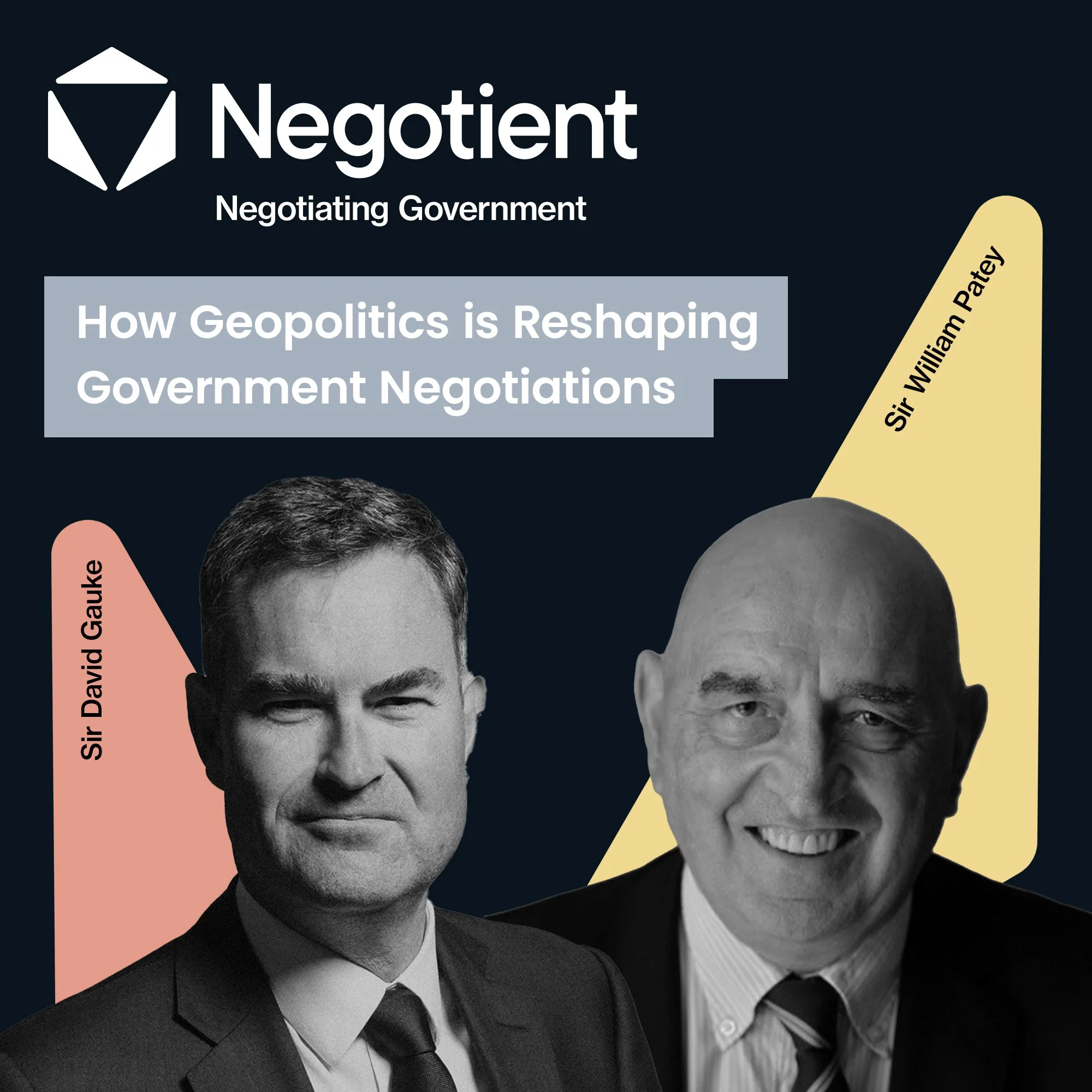
Geopolitics is becoming an increasingly important factor in government negotiations.
The relatively predictable global environment of recent decades is giving way to greater uncertainty. Trade relationships are changing, protectionism is increasing, supply chains are vulnerable and governments are reconsidering their reliance on overseas suppliers and traditional allies.
In this episode of Negotiating Government, David Gauke is joined by Sir William Patey, former British Ambassador to Afghanistan, Saudi Arabia, Iraq and Sudan, to explore what this changing geopolitical landscape means for businesses working with government.
They look at the growing emphasis on Buy British, economic security and domestic industrial capability, and why businesses can no longer assume that winning a government contract is simply about providing the best product at the lowest price.
Subscribe:Geopolitics is becoming an increasingly important factor in government negotiations.
The relatively predictable global environment of recent decades is giving way to greater uncertainty. Trade relationships are changing, protectionism is increasing, supply chains are vulnerable and governments are reconsidering their reliance on overseas suppliers and traditional allies.
In this episode of Negotiating Government, David Gauke is joined by Sir William Patey, former British Ambassador to Afghanistan, Saudi Arabia, Iraq and Sudan, to explore what this changing geopolitical landscape means for businesses working with government.
They look at the growing emphasis on Buy British, economic security and domestic industrial capability, and why businesses can no longer assume that winning a government contract is simply about providing the best product at the lowest price.
David and William discuss:
How the shift from a relatively stable global order is changing UK government decision-making
Why Buy British and economic security are becoming more important in public procurement
How security of supply can become a competitive advantage in government negotiations
What changing relationships with the US and Europe mean for defence procurement
Why government may increasingly support domestic industrial and technological capability
How geopolitical choke points, critical minerals and semiconductor supply create new risks
The growing importance of energy security to UK economic and industrial policy
How government will balance net zero, energy costs and the demands of AI and new technology
Why geopolitical disruption can suddenly affect industries that previously appeared relatively insulated
What businesses should do differently when preparing to negotiate with government
The central lesson is that businesses need to understand the pressures facing government before entering a negotiation.
Competitive pricing and a strong product remain essential, but increasingly they are only the starting point. Businesses that can demonstrate how their proposition supports resilience, security of supply, UK capability or another strategic government priority may be able to create negotiating advantages that go well beyond price.
Note: this podcast was recorded before the recent change of Prime Minister.
Featured on this episode

David Gauke
Chair
Negotient’s chair is David Gauke, a former Member of Parliament and Cabinet minister.
As Chief Secretary to the Treasury, David negotiated public spending settlements with Government departments and devolved administrations, led public sector pay policy, and engaged with policy issues including infrastructure investment, health reform, and defence procurement.
David is a City solicitor by background. He appears frequently in the media as a political commentator, is a columnist with the New Statesman and ConservativeHome, and edited the book The Case for the Centre Right.

Sir William Patey
Senior Advisor
Sir William Patey was a senior British Diplomat until April 2012. He served as Ambassador to Afghanistan (2010-2012), to Saudi Arabia (2007-2010) to Iraq (2005-2006) and to Sudan (2002-2005). He was also Head of the Middle East Department at the Foreign and Commonwealth office from 1999-2002. He was also Director of the FCO Comprehensive Spending Review from 2006-7.
Since retiring from government service in 2012 he has become an international consultant and regular media commentator on Middle East affairs. He has been Chairman of Turquoise Mountain Trust since 2019 and became Chair of the Labour Middle East Council (LMEC) in March 2024. He was a member of a Challenge panel for the recent Defence Review Chaired by Lord George Roberston.
His previous positions include Non-Executive Director HSBC Bank Middle East (2012-2019) and Chairman of Swindon Town FC (2012-2013). He served as the PM’s Special Envoy for Aviation Security (2015).
He was honoured with a KCMG in 2009. He is an Honorary Fellow of Exeter University and Distinguished Fellow at Royal United Services Institute (RUSI). He was awarded a Doctor of Law (Honoris Causa) by the University of Dundee in July 2016.
Transcript
Hello, this is David Gauke, Chair of Negotient, and welcome to the latest in our Negotiating Government podcasts, where today we're going to be discussing geopolitics and what that means for government negotiations in a whole range of contexts. And I'm delighted that we are joined today by who better than Sir William Patey, former ambassador to Sudan, Iraq, Saudi Arabia, and Afghanistan. Quite a lot of geopolitical experience doing those roles.
William, welcome.
Thank you. It's great to be here.
And let's kick off with why geopolitics shapes UK negotiations in a way that perhaps we haven't seen for some time. It feels like we've moved from a world where negotiations with government were fairly stable, to one where geopolitics is a factor and there is constantly shifting ground. Now, let's get the big picture here.
William, what's changed?
Yes, well, quite a lot has changed. I mean, the UK has been a country that has based its economic success on a globalised economy. We're free traders.
We were in a huge single market for quite a long time. But that world has changed, not just for the UK with Brexit, but globally. We were in a unipolar world which was rather predictable. The United States was the dominant power. We had a rising China. The Cold War had come to an end. And there was a degree of predictability to geopolitics.
But we're now in a world of shifting sands, I would say from my Middle East experience, where we're not quite sure where we are yet. We've got a different United States focused on tariffs and economic stability. We've got a China that rivals the United States
We're not yet in the sort of bipolar world that we saw with the United States and Russia, but we're moving towards it. But there's quite a lot of space in between where things haven't settled down. You see it in Europe with the Russian invasion of Ukraine, Britain's negotiating its new relationship with the European Union and with other countries.
In the Middle East, you've got the global oil shock, you've got an Iran which has survived an attack by Israel and the United States. You've got different alliances emerging between Turkey, Egypt, Saudi Arabia and Pakistan as a new force in the area. And then you've got the UAE, United States and Israel.
So it's just an example of how things are changing, how the global trading environment is changing, and how what were once very stable, predictable alliances are no longer stable and no longer predictable. So that is changing the calculations, not just of the British government, but of other governments with whom they deal.
I think that's really helpful context. And let's apply that in a few specific areas to see how that makes a difference for businesses operating with the public sector in one way or another, or who might be affected by a change of policy as a consequence of these shifting geopolitical sands.
Let's start with the issue of protectionism. So as you were saying, William, this is a different world in terms of the approach to trade. We've moved away from the trend towards opening up of markets to much more instability now. And one of the consequences of that is when you start to hear politicians and senior ministers talking about “Buy British” rhetoric in a way that we probably haven't heard for a very long time.
When I was in the Treasury, talk of “Buy British” would raise concerns, because does that mean you're overpaying? Are you getting the best value for the taxpayer? But now we're hearing Rachel Reeves, for example, talk about it.
What does that actually mean for negotiations when there is this tilt towards buying British?
Well, I think companies who are negotiating with the British government have to understand where the British government is coming from and what its calculations are, because any government purchaser always wants value for money. I mean, that's a given. But in a world where economic security and access to reliable sources of supply matter more, that has changed the landscape.
Britain became a just-in-time economy where they bought the best and the quickest and they didn't build up stocks. That has changed. People can't rely on getting goods just in time. They have to have access to reliable suppliers and at a reliable price.
Now, anyone negotiating with the government is not just negotiating on price, but on these other considerations. What is the tariff on the inputs to this project or contract? Are they likely to change at short notice? Can I offer something to the government that feeds into their agenda of economic security, building the British economy, having a secure source of supply, or even maintaining industrial production in this country in ways they might not have worried about five or ten years ago?
Previously, they would happily buy from America or Europe. Now, you want to have a steel industry. You want to have security of energy supplies. You want security of inputs to whatever you're contracting for or building.
So these considerations have become much more acute, whether you're in semiconductors, pharmaceuticals or the energy industry. There's a whole new range of geopolitical factors to take into account.
So it's no longer just about, “Are we the cheapest? Are we the best?” You've got to approach it with, “How will this seem to the British government, given all the other things they're having to balance?”
Yeah, I think that's a really good point. And if I make a very Negotient point, we're always making the argument that you've really got to understand what is going on in the head of your counterparty. And at the moment, thinking within government is going to change.
We haven't specifically talked about defence, for example, but in a world where the UK government is thinking about its relationship with the European Union, where there can be concerns about the US as an ally in some circumstances, you can see why heavy reliance on the US is something that over time the government might want to move away from. That's got to be a consideration.
Well, that's a great example — the defence sector. I was tangentially involved in the defence review that George Robertson brought out, and it exposed some of the UK's weaknesses. What has happened is it's also exposed our over-reliance on the United States.
So any British government going forward, spending money on defence, will want over time to reduce that reliance and have indigenous capability. Because you never quite know what the US will do. I never thought I'd see this in my lifetime.
The US has clearly become a less reliable partner. And I don't think it's just a Trump factor. I think we're seeing a trend here where the US is less inclined to get involved. It's a less reliable partner than it used to be.
The British government will also want to have more indigenous capacity, or capacity with its European allies. They've already committed the €1 billion necessary to buy into the European defence network. And if Europe is going to reduce its reliance on the United States, it's going to have to be a collective effort.
So if you're in the defence sector and you're talking to a British government or even a European government, you have to take that into account. Have you got an offer that plays into that self-reliant, less dependent-on-the-US approach?
Because we're not going to be able to get away from dependency on the US in a decade, but we're going to want to reduce it. And we're going to want to build up our own domestic capacity as a British government — any British government. This isn't just a Labour thing. Whoever is in power five or ten years from now is going to be thinking in these terms because that's how the geopolitics is playing out
Yeah. So I think the lesson here is that this isn't just a price negotiation. It's more complex than that. And you are operating in a different world with different considerations in play than we've seen in the past.
Now, you've described a much more uncertain geopolitical environment. In terms of how government negotiates, we've touched on this a little bit, but how is this changed environment impacting government negotiations more widely?
Well, we've yet to see exactly how this will play out. You mentioned Rachel Reeves earlier. In the old days, whichever government department you were buying for, they had the Treasury over their shoulder basically saying, “It's value for money. It's the cheapest price. Don't overspecify.”
That hasn't changed. I remember that well. The Treasury hasn't changed.
But it is indicative that the Chancellor is saying, “We want you to buy British.” And you can ascribe all sorts of political reasons behind that. But she’s making two points.
One is that the survival of this government, and its ability to meet the various demands on it, will depend on how well the economy grows. But not just how well the economy grows — it’s the nature of that growth. What they want is growth in the UK. They want to reverse some of the de-industrialisation that went on.
I won’t accuse you too much of that, David, as you were in those governments, but they want to reverse as much of it as they can.
You can see the strategic direction. If you look at AI, the investment in servers, the investment in energy, these are all indications of the government’s future plans. The government is going to get involved in a lot of areas where they haven’t been involved before.
So this is a new playing field. Even the Treasury is having to bend with the wind in this particular climate.
But it’s also clear they haven’t changed overnight. You’re still going to have to address the value-for-money question. But what you’ll also have to do is offer the department you’re bidding to, and the Treasury, good arguments as to why they should contract with you.
And if they’re paying more, why they’re paying more. You need to give them arguments they can use with the broader public, with Parliament and with the National Audit Office.
The basic foundations haven’t changed. But if you’re a company negotiating with government, you can provide them with the arguments that justify why they might not buy the cheapest option, why they might not buy from a foreign supplier, and why they should buy British.
So it’s about giving them the ammunition to make the right decision.
Yeah, I think that’s right. Although I’ve got my own personal theory on Rachel Reeves’ positioning on buying British, which is that I suspect she thinks that’s a message that would land quite well with the Burnham administration. But even that is very revealing in itself. It suggests that’s a trend that’s going to continue whatever the reason is.
Rachel’s a shrewd reader of the political tea leaves, so that’s my theory in any event.
We’re also in a world of volatility. Is there anything in terms of that? Because it strikes me that we’ve seen an awful lot of disruption in recent years, whether we go back to COVID, Russia’s invasion of Ukraine, or events in the Middle East and the Strait of Hormuz.
I guess this geopolitical uncertainty is also one where businesses need to be careful about disruptions to supply chains as well.
Yes. And you’ve got to be ready for that. I think the lesson from the potential closure of the Strait of Hormuz is that it pushed the price of oil up, but also affected so many other commodities — from helium for semiconductors to fertilisers and the impact that has on agriculture.
So the complexities and uncertainties increase.
I don’t think the Iranians themselves, five or ten years ago, would have thought they could close the Strait of Hormuz without much greater consequences than we’re currently seeing. So you’ve got choke points all over the place — the Malacca Strait, the Bab el-Mandab Strait. Geographically, there are vulnerabilities everywhere.
You’ve also got the quest for rare earth minerals, and the concentration of semiconductors in the hands of a few countries. That’s going to create new demands and new options.
Certainly there will be relationships with countries we haven’t historically had strong relationships with because they possess rare earth minerals. And we’re obviously going to have to reduce dependence on Taiwan for semiconductors given Chinese ambitions there.
So it’s a world in flux. Britain won’t be in a position to influence much of that, but it will want to take it into account when shaping its own economy and purchases.
I think one of the biggest areas is energy security. One of the lessons from the Strait of Hormuz, and indeed the invasion of Ukraine, is the importance of energy security. So Britain increasing its sustainable energy — wind, solar and nuclear — on an indigenous basis is going to move much higher up the priority list.
Yeah, I think that’s right. And let’s come back to that in a moment. But there are probably a couple of takeaways here for businesses.
First of all, you may need to protect yourself if you’re entering into a contract and are exposed to some of these vulnerabilities. That might mean avoiding being locked into something risky and structuring deals differently.
Second, if you’re less exposed than your competitors to international disruption, that’s a helpful attribute. If your goods or services are less vulnerable to global shocks, then that’s something to bring into play in negotiations.
It makes you a much more attractive proposition. It means the government is taking less risk with you than it might be with somebody else.
And understanding that gives you some negotiating leverage.
So understanding where your competitive advantage is matters. It won’t always be price or quality. It could be security of supply, energy security, or other factors.
And understanding that these things are important to the people you’re negotiating with will be key.
So negotiations with government are no longer simply about the best price and the best quality. There’s a whole range of other considerations now.
Yeah, absolutely right.
Now I do want to come back to this point about energy that you raised. Energy is a really interesting policy area at the moment because there are clearly a lot of trade-offs here.
There are competing objectives around net zero, for example, but also short-term costs. Manufacturing industry in the UK pays a lot for energy at the moment, and that’s becoming an increasingly important political issue.
So this is really an area of competing pressures. How does that play into negotiations?
Well, for a start, it plays into almost everything this government — and I think any future government — is thinking about.
They’re thinking about where the future economy is going to come from. The future economy seems to exist in Silicon Valley and China. But the UK is the third largest investor in AI and new technology, so the government is going to want to build on that. And that has implications for energy.
To run these servers and quantum computers, you need gigawatts of new energy. And if you’re going to adhere to anything close to net zero, you’ll have to do it sustainably.
So there’s going to be huge investment in wind, solar and nuclear because these industries need dedicated energy infrastructure.
I think the British government will want to be in a position to offer companies like Meta, Google and OpenAI a secure base from which to operate. That’s going to be important for stability.
You also need a tax base to fund this new economy. So energy is absolutely critical.
And I think it’s also going to mean some compromises on net zero. Net zero has often meant “no North Sea oil”. North Sea oil and gas isn’t some great panacea — we’ve already developed most of it and what remains is marginal — but it sends a signal.
I think you’ll find that if you’re in the energy business, the government may become more receptive to licensing and development.
But if you’re negotiating with government in this area, one of the key things that will be attractive is how your offer aligns with commitments to net zero and sustainability.
So if you’re Rolls-Royce and you’re producing small nuclear reactors, the ability to do that indigenously in the UK, with a secure supply chain and within an attractive timescale, will matter as much to government as cost — although cost will always remain in the background.
So throughout the energy sector, government will want to harness what Britain has to offer. And if you can frame your offer in those terms, it becomes much more attractive.
So really, if you can reconcile those competing tensions on energy policy, then you’re in a strong position rather than forcing government into a choice. And once again, this is an area where it’s not just about commercial decisions. You’re operating in the world of politics.
I think political choices have become much more difficult, much more complex and much more relevant.
There was a time when it was simply about price and whether something met the specification. If it was the cheapest and met the spec, there was very little justification for deviating from that. You certainly never convinced the Treasury to do so.
But the world has become more complicated and there are now many other factors in play.
And it varies from industry to industry. Whether you’re in energy, shipping or pharmaceuticals, the implications are different.
Look at pharmaceuticals. COVID taught us that you need some control over vaccines because people become very nationalistic when it comes to the health of their citizens
You can’t afford for all pharmaceuticals to be outsourced. Donald Trump has made this absolutely clear in terms of pricing and getting pharma companies to relocate to the US.
So British and European governments are going to want some degree of control over that.
It almost doesn’t matter what sector you’re in. This new environment will affect you in some way, and it’s important you understand it.
Yeah. And just to give another example we know something about — the bioethanol industry — suddenly in the UK it was massively disrupted by the UK-US trade deal. Indeed, something that happened in the final moments of that negotiation suddenly changed the whole picture.
Industries you wouldn’t necessarily think would be massively affected by geopolitics can suddenly find themselves disrupted.
So let’s bring all of this together then, William. If you’re a UK-based company about to negotiate with government today, what would you be doing differently given the geopolitical context?
Well, the first thing is that you have to understand the government’s pressures and constraints.
Put yourself in the position of the person you’re trying to sell to and negotiate with. In your field, what is impinging on them? What are their strategic goals and what influences those goals?
Is it trade deals? Supply chains? The threat of disruption?
Understanding those pressures and constraints will be very important because they translate into specific implications for different sectors in different ways.
I suppose what it means for British companies is that government is overwhelmed by problems. If you’re offering solutions, that’s going to be welcome.
It’s like Margaret Thatcher used to say: “Don’t bring me problems, bring me solutions.”
So if you’re a British company bringing a solution to government, make sure you emphasise it. Don’t hide your light under a bushel.
It’s about understanding your customer and the constraints they face. Obviously, you still need a good product at a competitive price that meets the specification. But that’s now just the starting point.
Understanding the pressures and constraints on government is the new critical factor.
Yeah, I think that’s really helpful.
As always in a negotiation, it pays to understand where the other side is coming from and, to some extent, walk in their shoes. But there’s a stone in that shoe at the moment in the form of the geopolitical situation.
That’s something anyone negotiating across a whole range of sectors is going to have to understand.
It’s pretty clear that this uncertainty and volatility is something businesses have to appreciate and work with, and in some circumstances even turn to their advantage.
So Sir William Patey, our man in a number of quite exciting places, thank you for bringing your diplomatic and business experience to the table today.
And thank you for listening to the latest in our Negotiating Government podcasts.
Note: this podcast was recorded before the recent change of Prime Minister.